Wednesday, January 22, 2020

Is the Medium the message? Touch-Tones(TM) on the iPhone say no, at least not yet.

No. The medium can influence the message, but only after people die.

Mimesis: the tendency of new forms of information to mimic old forms of information.
Then, as the oldsters die off, the medium takes over.

I'm taking a fascinating class at Stanford Continuing Studies: "The History of Information" (Beyond Bits and Bytes) taught by Thomas S. Mullaney (Professor of History.)

Professor Mullaney is teaching us about how information is put "in formation" by different technologies. How those technologies govern how the information is transformed ("transformation") and how it starts out always the same, but eventually the medium wins out and takes over what can be done. The Gutenberg bible looks like it was written by a scribe. Why is that?

Tonight's lecture was particularly interesting. And one concept was a real shock to me. I've read Marshall Mcluhan's book: "The Medium is the Message" (a really fun book) but never really got the point. Tonight I believe I finally understood what Marshall was blathering about.  It only took one picture to explain it to me.  Professor Mullaney put up a picture of the original iPhone dial screen and asked "Why do the keys send out Touch-Tones? They are obviously worthless in terms of an actual telephone call, and they have no current practical use except to annoy you - how do you turn them off?"

Wow. It really hit me. Apple, the experts at user interface, had just mimicked the last generation desk phone technology into a device that had no need for it, no desire for it, actually diminished the usefulness of the device. Why? Why would Apple do this? Is it because they want the experience to be as unchanged as possible, to be as 'comfortable' as possible to those users who owned the previous technology? It must be so, as there is no other reason to annoy everyone else without some payoff.

A long time ago, these beeps, boops and Touch-Tones signals actually were functional. They did things when sent over the phone system. Ever hear about a "blue box"? Or Captain Crunch? If not, get ready for a Silicon Valley adventure story that has been repeated over the centuries. The more things change, the more they stay the same.

First, it will be educational to learn about the evolution of the phone system. When Alexander Graham Bell (yes, the Bell system is named after a real person) first invented the phone it was a point to point system, like the tin can and string system you played with as a kid. One phone on each end of the system. Your phone talked to the one on the other end. In the1890s this is how phones worked. You had two phones connected to each other and nowhere else. Manhattan became a nest of wires, executives had phone banks near their desks, one to the factory floor, one to their lawyers, one to their largest supplier. This would never work as the system tried to scale. one phone for everyone you ever wanted to call! But...

Alexander was a very smart man

And he saw a simple way around this: he invented the switch board. Your phone was connected to the switch board. So was your phone on the factory floor. So was your lawyer's phone, so was your supplier's phone. If you wanted to call any of them you would pick up your phone and an operator would answer. So everyone's phone was connected to one other phone: the operators. But... the operator had a set of plugs in front of her that all the other phones were connected to. So you could tell her who you wanted to talk to (It was almost always a her, in fact, my mother-in-law worked as an operator for many years! And she's now happily retired with the couple of shares of stock she got as bonuses...) The operator would unplug the phone line going to your phone from her phone and plug the phone line into the person's phone line that you wanted to talk to. Voila! All the wires go to a central place and a human routes the calls in real time. So instead of having a phone for everyone you wanted to talk to (which scales as the number of phones squared - a thousand phones, a million wires) you had one wire going to a central place and the connection was physically made by an operator to whichever phone you wanted to talk to. Now it scales linearly with the number of phones.
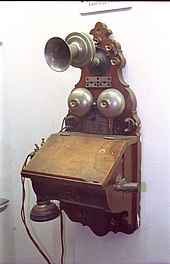
Wall phone, operator required!
See the wall phone over there? Notice, no dial. You just turned the crank to notify the operator, spoke into the horn on the top and listened by the horn on the side. Simple. When you turned the crank it would connect then disconnect the line to the operator. This line had a voltage over it, so when it connected it turned on a light at the operator's switch so she could tell who was calling. It would flash, as turning the crank connected, then disconnected the light.

Okay, it was actually a little bit more complicated than that. The operator really couldn't plug the phones lines directly into each other, there were tens of thousands of phones in Manhattan. She would actually have to make several plugs and rewire the system in real time, this was the only way they could get it to scale. A few years later there were hundreds of thousands of phones in Manhattan. Even though this is now scaling linearly with the phones it's not going to work, there aren't enough people to manually reroute the connections on every call.

Somehow, Bell needed to get rid of the operators or his business was going to fail. And again, he was a very smart man. He assigned a number to each phone. Four digits. You could have 9999 phones hooked together through a switch system. Each group of phones had three digits to identify its group. So you could have 999 groups of phones (although some of the numbers were reserved.) This means he could now support about ten million phones and every one had a unique number. Yes, the telephone number was invented. The operators got a call, you told them which number you were calling and they set the switches to route the phone call correctly. But wait, Alexander still needed all those operators! But again, Bell was a very smart man.
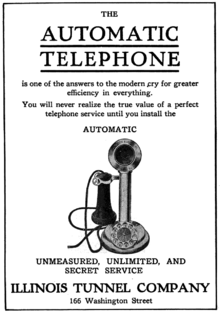
The operator flipped the switches to match the phone number you wanted to call... what if  your phone could do that all by itself? Then there would be no need for operators. That's exactly what he did. He made the phone capable of sending a signal through the wires that would flip the right switches to connect your phone up to any other of the ten million phones. How did he do that? Well if you've ever watched an old movie you see that phones used to have dials on them (that's why we call making a phone call "dialing".)  The dial was a rotary switch.

Unlike the crank the numbers on the dial told you how many times the switch would be turned on and off when you moved it all the way clockwise and let it go. Put your finger in the five hole and rotate the dial clockwise to the stop and let it go. It would connect and disconnect five times as the dial returned to its original position. So it would flash the light at the operator's switch five times. Who cares? Nobody! But....

Alexander was a very smart man.

Instead of using that signal to flash the light five times he made that signal turn another rotary switch five places. That switch now connected your phone to the fifth wire connected to that switch. Then the next number you dialed would change the next switch! And so on and so forth. If you wanted to talk to a phone in your local group,  you only needed to dial four numbers. And voila, you start ringing the phone at the other end. Now if you wanted to talk to another group of phones you could continue dialing the next three numbers and three more wires would switch and connect and all of a sudden you're talking to another phone in another group, automatically, no need for operators, you only need big buildings with big physical switches in them.

This system has been expanded to nine numbers in the US. We add the area code to the groups of switches and now you can hook up ten billion phones. Another consequence of this system is that you didn't have to use the rotary dial to dial the number, you could just press the switch that connected you with the system the right number of times to dial the number you wanted. 0 was the hardest number to dial as it was really ten connect-disconnect cycles. And you had to do it within about a second or the switch at the other end ignored you. But it was possible. It was a quirk of the system and you could hack it to dial any number you wanted.

A quick digression. How do you call a phone in another country? Well you just add a country number onto the phone number. That's why the country number for the United States is "1". We invented the phone system so we got to set up the naming. We're number one!

What a great design! But there's still some problems in the system. These switches are big. Typically they are thirty or fourty feet tall so they need a lot of building space. When you see the phone company building without any windows, that used to be just a big shell around a bunch of switches. If the phone system actually grew to ten billion phones that'd take a billion switches. There weren't enough buildings to hold all those switches and all that wire. But...

Alexander was a very smart man.

But... by now, it's the late 1950s and Alexsander is dead, so he can't fix the system. But he's invented the largest research laboratory in the world and he's got a lot of smart people working on this problem. What do they do? Did they invent the iPhone? Nope. If they had we would have gotten a picture of a rotary dial instead of the push buttons. And it would be going dit-dit-dit-dit... not beep, boop, bop. Instead they invented the "Touch-Tone" system. Instead of letting the voltage - ground - voltage move the switch, they now had a little electronic circuit that listened on the phone line for the Touch-Tone sounds. When it heard the sound for a "1" the electronic circuit turned the switch and connected up the first wire. Then when you pressed the next number and it did the same thing again. They originally used this system to connect up the groups of phones with each other. They thought they were being very clever as the signals are in the audible range and thus can be transmitted over any of the phone lines already in existence. No need for new wires anywhere! But...

They started using these tones on pay phones - the system in the switch could hear the tones that the quarter set off when you shoved it into the phone's pay slot. But it's just a tone in the audible range. So you don't need to put a quarter in the phone, you can just replay the sounds the quarter triggered when you shoved it into the pay phone slot. So with a little tone generator you could get free phone calls. Even better, they had special tones (that they published!) that would let you dial long distance phone numbers and pay for them. No need for collect calls with the tone generator (the "blue box") you could call anywhere for free.

Another quick digression. We're all the way up to the 1970s now and bright electronic students (even those in high school, like the esteemed Steve Wozniak) could figure out how to build these tone generators. One of the tones was actually able to be generated by the plastic whistle that was a prize from a box of Cap'n Crunch cereal, hence the nickname of John Draper (an early phone phreaker.)  You could sell these blue boxes, which cost a few dollars to make, for a hundred dollars because people could use it to steal long distance phone calls from the phone company. Stealing is a harsh term. It's not like the phone system noticed that one person made a free phone call and it would break the system! It wasn't even a real annoyance. The phone company didn't care. And some blue box builders made enough money to buy parts to build a personal computer. One hack finances another.

At this point Cap'n Crunch is actually working at Apple. He's building a blue box that can be controlled by an Apple computer. But the corporate side of the Wozniak/Jobs dynamic duo gets wind of it (the corporate one wasn't Woz, if you didn't know) and shuts it down. You can't have everyone who buys an Apple computer making free calls! What would this world come to? So Steve fires Draper, even though that's why he hired him in the first place. A real dick move. And not the only one the Dick, er Steve ever made, but that's for another blog post...

Back to our story about the iPhone's crappy 'dialer' interface. Again, it's not a dial, it's actually a Touch-Tone interface with simulated push buttons like the modern phones. By the 1980's the phone company figured out that putting their signalling in the audio band is a bad idea so they invented the Signaling System Seven.  ("SS7" for short. I was never sure what the other six generations of signalling were, we've only described four in this article. I doubt there were seven. There were probably way more.) So at this point in time the globally open in-band signalling system no longer works. You can't get free long distance calls by blowing a Cap'n Crunch whistle into a phone anymore. But you can still talk to the local switch using the Touch-Tones. Beep-boop-bop. All the new phones do it.

So what happens when they invent the cell phone? They don't use the Touch-Tones at all to dial, but you can do all kinds of neat things with Touch-Tones. "Press 1 for a representative." The cell phone produces a Touch-Tone signal that you can hear, then sends an electronic signal across the radio waves to the switch on the other side which recreates the actual Touch-Tone signal so the representative on the other side can ignore you for minutes at a time. The Touch-Tone signal itself is never sent over the phone lines on your end, but we still hear it. We're mimicking the original system that no longer exists! Mimesis. That's why you're iPhone still does it. Beep-boop-bop. We've been trained to expect the tones, so they gives us the tones.

When will we ever get rid of this anachronism? Who knows? With this new system there's no need for Touch-Tones, but we still have them. Maybe after the original designers die off, we'll forget to put them in the next version of the iPhone.... so it won't beep-boop- bop in your ear when you press the buttons. The new Media doesn't need the old messages.

Thanks for reading.
  -DrMike.


Quick aside. When I turn the page on an electronic book it pretends to simulate the turning of the page of a real book in three dimensions. Talk about your anachronistic medium is not the message but copying what went before is, that's the ultimate baloney interface hack.

Oh, what a tangled web we weave,
When first we practise to deceive!


Thursday, December 26, 2019

Ten Grand Technical Challenges of the 21st century: 1. Settle Space, Mars, moon, asteroids, the solar system.


Settle Space, Mars, moon, asteroids, the solar system.


The first of the Ten Grand Technical Challenges of the 21st century


TIme for some more blogging. One blog post on each of the TEN GRAND CHALLENGES of the 21st
century. The things that make us proud to be a part of the human race. The things that we should be
doing regardless of what else is true, the things that make life have meaning.


Humanity will infect the galaxy; we already are.

Humanity has a chance to make a real mark on the universe. If you look at what we've been throwing
out into space for the last 50 years, it's obvious we have some innate need to expand into new
environments. People have been in space almost continuously since 1971 (that'd be ~50 years) and I
detailed the history of the technology in this post [1] about how technology changes things.


We keep throwing robots out there as fast and as far as we can. They aren't yet killer robots (we keep
those closer to home so far [2]) but they are certainly robots. Eventually we'll be sending out ones that
can reproduce. If we will, so would the aliens. It doesn't take too long before these robots infect the
galaxy. But mostly what they do is just watch. We've been transmitting TV signals for decades, but that
means we've only announced ourselves to 100 cubic light years whereas the volume of the galaxy is
100x10^15 cubic light years. How much of the resources of a galactic civilization would be able to
focus on earth? Not very much. The correct comparison is if one atom in your body all of a sudden
started sending out electrical signals, would you notice? I wouldn't.


But, don't worry, the aliens and their killer robots will notice us sometime. I think they have already
noticed us. It's hard to miss all the hydrogen bombs we've set off since 1950. But still, even if they did
notice, it will take a long long time for them to get here. If I could only live that long [3] it would be
amazing! The only counter theory is that the robots that are watching us would now be growing aliens
from the DNA equivalent they use and operate independently. If the speed of light is really the limit on
transmitting information, living organisms as large as the galaxy are going to be very slowly acting.
For a signal to propagate to half of the galaxy takes 50,000 years. Since our recorded history is less
than 5,000 years we have no practical experience of what a society like this would be. But enough of
the wishful thinking. What are we going to do before the killer robots get here?


What's the most efficient way for Humans to infect the Galaxy?


Assuming we want to settle the galaxy most efficiently (at the least cost per year) and cost is
measured in time. Time is money, but money and time is what people's lives are made up of. People's
lives compared to the time scale of a galactic society is about 1000 to 1. Seems like they would barely
notice each other. So for now, we will ignore any effects that the alien killer robots would have
(although in my opinion, the alien killer robots are already here.) [5]


We want to put our robots and our people throughout the galaxy. Given the vast distances between
habitable areas they are going to evolve independently of each other. So we need to learn how to
guide their evolution in the right directions.


Bottom line: humans are going to infect the universe, whether you like it or not. So what is the most
efficient way to do this ? I' m a big fan of going everywhere as fast as possible. So, I'm a big fan of the
space station. We need to keep one manned forever. After the space station (which is the most
expensive structure ever built) which has been in orbit for almost 50 years, we need a base on
another planet or moon. Where should it be?


Humanity should settle on the moon first, then Mars.


In my estimation we definitely need to go to Mars. But, on our way their we need to practice putting up
a colony, and the easiest place to do that is on the moon. It's nearby, easy to deliver food and shelter
to, easy to rescue, cheaper and faster to get to than Mars. It will give us the experience we need to
learn how to inhabit other worlds. It's definitely going to be cheaper than going all the way to Mars.
Except, water is harder to come by on the moon. We'll want to be at the south pole where some water
has been found in crater shadows. We can learn how to make rocket fuel from the existing landscape,
which is critical to making a Mars colony work. If it takes us awhile to make this happen, it won't
matter on the moon as we can go fly rocket fuel to the moon, whereas getting it to Mars is extremely
expensive.


So settling on the moon has huge advantages in cost and in nearness (time to get there) over Mars. It
gives us the chance to learn how to settle humans on the first body outside of the earth and helps us
get to Mars with more confidence. We should do both, but we can start going to the moon right now.
We don't have to build a new rocket, we can use the one's we have. This is a huge advantage. We've
already settled space (the international space station) and now we need to settle moon and learn how
to settle Mars and the asteroids, of course.


What's next? The stars. [7]


"A potentially habitable, Earth-sized planet orbiting the Sun’s closest stellar neighbour—Proxima
Centauri, a mere 1.3 parsecs, or 4.22 light years, away."


Wholly cow! This planet is actually close enough for us to reach with next generation technology. And
some billionaire is helping to finance it: Starshot [8] and a list of the technology they need to develop:
mostly lightweight chip packaging (they're essentially sending a cell phone into space) and some
software and materials work on the lightsail and the laser to control the actual sailing. They've already
produced a system design of how to get to Alpha Centauri, published in the British Journal of
Interplanetary Society. [9]

On the current schedule they plan to send signals back from the Star in 2060.


Then there’s the next question: How do we actually get people onto these planets? Intergenerational
space ships? Baby farms? Teleportation? All the current ideas sound ridiculous. But just wait, it's only
a matter of time and another blog post.


Thanks for reading.
 - Dr. Mike


=======================================================


[0] We price commodities in terms of saved time. Price information the same way. This will
revolutionize economics. A way to fairly trade between realms. Realms can publish 'magic' or
technology (steps to produce something) and that something can allow a conscious entity to perform
a particular skill. A skill allows the user to cast a 'spell', a set of defined steps (algorithm) to produce a
given output. So time to output. What are examples of outputs? AIs. Cars. Rockets. Planes.
Spaceships. Energy. Nuclear power. Would we trade the hydrogen bomb around? If you don't know
how to do that, I don't see how you'd be able to listen to the galactic internet. Another blog post is due
on how you make it profitable to run an intergalactic internet? And what would you use that network
for, given the 'power' of the network is limited by the huge latencies in the galaxy: 50,000 years or
1.7x10^12 seconds. 1700 trillion seconds.


The power of a network that covers the galaxy is an interesting thing to investigate. The power of a
network is defined as the amount of information it can hold at one time. The throughput is how much
comes in or out of this repository of information, the power is how much is stored in the network, by
stored we mean information that is in transit, that is information that has been sent but not yet
received. Assuming a data rate as high as we can conceive, given physics and science. What are the
limiting factors? There are some distortions in time and phase and frequency that limit the data rates
you can transmit per hertz. And there's the fundamental limit that Claude Shannon determined. [6]


The power of a galactic network: xxx THz?


 These systems of flow are the subject of queueing theory [12] for which we define x as the average
time a customer spends in service and t as the average time between customer arrivals. Often we use
the following rate notation for these quantities: x = 1/µ (where µ is the service rate) and t = 1/λ (where
λ is the arrival rate). Further we combine these two quantities and define ρ = x/t = λ/µ as the system
efficiency (also referred to as the utilization factor); in
general, stable systems require ρ < 1.


Now this paper does not directly attack latency but ... it says: footnote 9: We do not explicitly address
latency due to speed of light, but assume such latency is included in the service time.


For a galactic civilization that latency, that service time, is 50,00 years or 170x10^15 seconds. So
µ=1/170x10^15=6x10^-12.
The arrival rate is zero right now. How much money should we invest in trying to pick up this signal?
You should be able to figure this out. The human race spends a lot of effort watching the skies. A lot.
I wonder if it's built into the genes?


How many offers per second can we expect? We can estimate this assuming trading information. Bits
produce an average saving in time of a procedure of x% per period. Or efficiency service time
increase of x% per period. It takes xxx bits to do this. We receive them at a rate of multiple Tb/s per
channel and there are one Trillion channels (every star in the galaxy.) And a technology requires
about a TB of information. That's enough to build a human being (take my word for it. Includes DNA
and experiences.)


So it's like one per second per terabit channel. Thousands? How do you trade this information? It's
rated in savings percentage per unit time. On the receiving side you have to multiply the proposed
solution by the percentage of it that is applicable to the existing situation, which will be less than 100
percent. There's always some friction in remote transactions. This is all formalized, in a paper by Paul
Krugman: "The theory of Interstellar Trade." [10]


[1] image timeline of space stations orbiting the earth
[2] radar controlled machine gun, drone
[3] what's the best estimate of the time until the aliens show up? I think we date it from the first
hydrogen bomb: 1950 according to the man who could predict something from nothing [4] there's a
95% chance of an extinction event occurring between 800 and 8 million years from now.
[5] Killer Alien Robots are already here. And you thought battlestar galactica was scary, wait until you
read the underlying books about the Berserkers by Robert Silverberg.
[6] Shannon's law is most similar to the uncertainty principle in quantum mechanics. It's hard to claim
that they aren't fundamentally related. They actually may be directly related... in that the uncertainty
principle sets the accuracy of measuring two variables simultaneously. Shannon's law sets the
amount of power required to transmit information reliably. To transmit information reliably you have
measure bits of signals accurately, this defines how much power you need to differentiate two
different signals. The detection is typically gaussianly distributed which requires the sources to be
separated by more than half their width to be able to be differentiated. This is the same requirement
made by quantum mechanics. This is the minimum noise that you will see in any system. This
quantum noise is unavoidable in the real world. It can't be edited out or corrected without sacrificing
latency. You can devise a code to run over a channel that will guarantee the data will be delivered
correctly but adds latency. According to Shannon's law the additional latency for additional accuracy
is exponential over polynomial? [XXX???} this needs filled out. Is it linear? What is the best you can
do?


[10] Economic Inquiry doi:10.1111/j.1465-7295.2009.00225.x
(ISSN 0095-2583) Online Early publication March 7, 2010
Vol. 48, No. 4, October 2010, 1119–1123 © 2010 Western Economic Association International


Thursday, January 10, 2019

Republicans vs. Democrats. It's not conservatives vs. liberals, it's authoritarians vs. progressives.

It's Authoritarians (Royalty lovers - L'estate, c'est moi) vs. Progressives (All men are created equal)

Republicans are more Authoritarian than Conservative. Conservatives want to pick an imaginary time in the past and declare it to be perfect. Authoritarians have a Father figure complex. Whatever the Father says is right. Anything else is immoral. [1]  So even though there is a streak of Conservatism in the Republican party, it's not really the basis of their morality. Their morality is handed to them by their Father, whatever he says is moral. To disagree with him is immoral. Pretty simple, easy for people who are too tired to think for themselves.

In contrast, the moral authority of Democrats comes from their Progressive, American ideals.

Progressives believe in the

  • Declaration of Independence:
    • Life Liberty and the Pursuit of Happiness
    • All men are created equal
    • The people agree on how they will be governed
    • No Royal authority is accepted
    • No one is above the law
  • The Gettysburg Address:
    • Government of the people
    • By the people
    • For the people
And the people care for each other and work through the government to provide public resources for all. You know, like flood insurance. We pool our resources and share the awesome results: roads, sewers, armies, regulated markets, health care, medicare, social security. public education, the internet. And we stop others from destroying these things by regulations: Don't pollute, don't cheat investors, don't lie for personal gain, network neutrality.

On the other hand, Republicans are all about being moral by following an all-knowing Father. No questioning the rules-giver! It's Strict Father Morality. They must uphold the Father's authority. This is why they are so enamored with made up religions. They need someone to tell them what is right, they don't want to take the mental effort to figure it out on their own. They are also completely tribal. Only our Father knows best; even if it's the same idea, if it's not from our Father, it can't be good!(This is why Republican ideas used by Democrats (Affordable Care Act) can't be good. Why? Because a Democrat supports them. They ain't in the in-circle so screw 'em.) The Father also must punish the children and the wives if they don't follow his fanciful moral laws. Especially if they are just doing things to feel good, that's punishable by physical discipline. If the discipline doesn't work, it's the child's fault. If the child doesn't prosper, they must not be disciplined enough, they can't be moral and so they deserve their poverty. 

There's a strict Moral Hierarchy that drives the Republicans and drives their laws. Yes, these authoritarians are the same ones that established slavery.

The Conservative Moral Hierarchy:
• God above Man
• Man above Nature
• The Disciplined (Strong) above the Undisciplined (Weak)
• The Rich above the Poor
• Employers above Employees
• Adults above Children
• Western culture above other cultures
• America above other countries
• Men above Women
• Whites above Nonwhites
• Christians above non-Christians
• Straights above Gays

And my in-group against yours. That is why they work so hard to dehumanize their opponents. It's not a joke. They really want to believe their opponents aren't human and not worthy of respect or Life, Liberty and the Pursuit of Happiness. They believe that is only for their group, hence they can't help but follow a  fundamentally racist ideology. This is why they have a hard time hiding & denying it. They know it is wrong and they are ashamed about it. It's a huge issue with their moral code, they see it and they don't know what to do about it. This is why they attack when it is pointed out to them; even though it's a fundamental tenet of their faith they wish to believe they are good (like everyone) and American. Since these two ideas clash, they are forever screaming in protest that they truly believe in the American dream, even though they actually just believe in bowing to the Father figure.

So we can now see where their legislation comes from. Give tax breaks to the rich because they are the most moral because they are rich, success must show moral superiority. Progressives know that success just reflects might, if you can steal from society Republican's think it must be moral because it's successful. Republicans can't treat everyone equally. It's against their moral code. This is why they support companies that pollute and kill poor people, hate unions, hate non-whites. Those people have failed and are morally inferior and deserve to be treated badly, even if the Republican is in one of those classes themselves! Don't help the poor or the disadvantaged, they deserve it because of their lack of morals. 

In other words they want to live in a world run by Royalty, the very thing that Americans got rid of when they formed their own country. But we didn't kick all the Loyalists out. We left about 35% of the population as Royalty supporting religious fanatics, because the majority of Americans, the Progressives, believe everyone should be treated equally and fairly. 

Sad to say that Authoritarians know how to exploit this. They have no qualms treating people differently, in dehumanizing those lower down in their hierarchy, they actually revel in it to show their fealty to the Father figure!

However, this is about to change. Free speech is awesome. Getting rid of heresy is awesome! Hateful speech targeting groups of others with death, physical threats and harassment is not. Many other countries have figured out how to do protect themselves from the Authoritarians. Look at Germany recovering from the Father of all Father cults, the Nazis.

Will America stand up to the Republican Authoritarian minority or will they allow them to continue to ruin this nation?

Do you want to strangle the last best hope of human kind (America) or do you want to be a slave to your Father?

It's up to you. 

Thanks for reading.
 -Dr. Mike


[1] George Lakoff  -  https://georgelakoff.com/2017/07/01/two-questions-about-trump-and-republicans-that-stump-progressives/  The man who understands it all. He gives advice on how to convert Authoritarians into Progressives. Framing is the key. Daddy isn't the state. The state is for providing public goods to help everyone. You can't be successful unless you work together. And not just locally, but globally.

Sunday, October 28, 2018

Free Will: What others have thought about it in the past...


The evolution of thought around free will:

God: You think therefore you have sinned.

Plato: I think I can imagine what is.

Renes Descartes: I think therefore I am.

Hobbes: I think we're better off together.

Adam Smith: We are better off together.

Charles Darwin: I think I selected you because you think.

Elvis: I think I love you.

Mick Jagger: I think I can't get no satisfaction.

Pink Floyd: I think it's just one more brick in the wall.

Richard Nixon: I think I am not a crook.

Daniel Dennett: I think I think therefore I think.

Sam Harris: I think therefore I am not really thinking.

Christopher Hitchens: I think therefore I need no god.

Richard Dawkins: I think because it gives me more descendants.

Donald Trump: I think I'm a very smart person

Scott Adams: I don't think, I just do. I have no free will... so I can be an a$$hole. It's not my fault! I can't help myself.


Sunday, June 3, 2018

Free Will: Do You Have It?

Does it even make sense to ask the question?  What if Free Will didn't exist? What difference would it make? What would be different in the real world?  Would we change punishments as people aren't responsible for their actions? Would more people 'give up' changing themselves? If there's really no Free Will, it doesn't matter. Nothing matters. But since I am going to make my life have meaning and matter, I think that means there is Free Will.

The people who don't believe in Free Will have nothing, nothing to support them.  They look for support for their ideas in the most amazing places and purposely work to refute anything that mismatches what was once written in a book. Some try to have current interpretations of  'religious' thought.  Religions assume Free Will. That's one thing we agree on. The Newtonians don't. They think that because we have equations that explain what happens next depending on what is happening now, that everything is predictable. Ha! That's laughable enough to cause a conniption fit!

Let alone their misunderstanding of Quantum Mechanics (where everything is probabilistic and depends upon the observer...) and their lack of knowledge of emergent properties - how an underlying set of rules in one domain can have an effect at another level. (Examples are different phases of water: ice, steam, liquid, etc.) Systems act differently than single instances. And they can't be predicted. At least they can't be predicted from anything less than a full simulation, and even then, it is not possible. This means that they are unpredictable.

What can we do with Free Will and the progress of Science?

We have Free Will. We also have an opportunity to make a true religion that is consistent with the facts and what we know and can grow and thrive in the presence of new information.

We have a unique opportunity when the Nerd Rapture happens.  We can actually choose what religion we want to make happen.  We can actually make any and all religions true in the minds of their followers. This is a fantastic opportunity for the Nerds. It's time to design what religion we want to make true.

Since we have Free Will, we can create whatever religion we want...

So what religion should we make into a reality? Any of them? All of them.  But we should also design our own religion that meets the secular moral code, believes in reality, allows anyone to join, and insists that all people are created equal? You betcha! What would that look like?

But wait, do we have Free Will, or is it just all an illusion?

First why do we think we have Free Will?

Is it just a matter of complexity?  We're so complicated that it appears that we have Free Will.

Or is it in the interaction of our consciousness with ourselves - does that mean we have Free Will?

What does that even mean. When I walk into a room and tell myself I see something, who am I talking to? Is there someone there who doesn't see the same thing as me? I don't think so. I actually think there is a separate consciousness that can't speak (see the famous corpus callosum slicing experiments...)

Is it just a matter of information? Is it just an illusion? How can knowing something be an illusion? What you perceive might be an illusion, but the perception of the illusion is real.

Like the famous physicist Claude Shannon said: information is the content in a message that cannot be predicted. [1]

Doesn't that definition assume that Free Will exists?  How can you do something unpredictable unless you have Free Will? It's not just that you are so complicated that it's not feasible to predict what you will do, we have to show it's fundamentally impossible.

And it sure feels like I make choices and isn't making choices the foundation of Free Will?

It certainly feels like I have Free Will. How could it be an illusion? What does an illusion or hallucination of an internal mind state even mean? It has something to do with reality, but I'm, not sure exactly what, yet.

If we settle the decision of whether or not I have Free Will, does it make any possible predictions change? Can it be scientifically measured? Does it have a consequence? If not, then it's not really a well framed question, is it?

So our first job is to define Free Will. And define it in a way that those who have Free Will will act differently than those who don't. Without that possibility you can't verify your reasoning.  If Free Will makes no difference then it doesn't matter if we have it or not. [Less is More blog]

Reality is what stays around even after you have no faith. You don't need faith in reality, it just is. Anything you must have faith for could be or could not be. And that's a tough thing to base your life on. You might have enough evidence to believe it, but beyond that, you are risking your eternal soul. If you have one. I'd argue you probably don't have an immortal soul...at least not yet. Science is hard at work in giving you one, but we aren't there yet.

Let's assume you don't have Free Will. Then your every action should be able to be predicted. That sounds hard. Harder than the weather. Things change all the time. To have to measure them accurately enough to predict what will happen in the future takes a lot of energy. If you don't know exactly where everything is to start, you can't say where it will be later. In a typical pool shot (absolutely following Newtonian equations) any error in the angle of the ball, the speed of the ball or the spin of the ball quickly grows astronomical in size after a few bounces and collisions. Yes, astronomical! How do we know this? Just look at how hard it is to predict the weather... we can't know the position, velocity and state of every atom. Not only is it impossible in Newtonian physics, it's inherently impossible in Quantum Mechanics (QM only gives you the probability of a particle being somewhere, so the errors get astronomically larger than in Newtonian physics.) So it can't be done.

What's the second way in which Free Will is obvious? The only way to say Free Will doesn't exist is to have a way to predict someone's future decisions. You can get pretty good at this by gathering lots of data and using it to build a model that makes predictions. But you're not going to get better answers by measuring less than every single atom's state. You're going to make mistakes in your prediction. The difference between the predictions and the truth are what show that Free Will exists.

So we can measure that Free Will exists given any model to do predictions. It's an easy thing to measure. You have Free Will. It's not an illusion. It can be measured. Free Will exists. Eventually the prediction model gets pretty good, but it will never be perfect. QM forbids it. You must have Free Will if you think you do.

Now, what religion do we create when the Nerd Rapture comes along? (Note to self: Nerd Rapture is that ability to put your mind elsewhere, where it can still have experiences, and, hopefully, back into your body.)  The religion we create for people to experience when their mind is elsewhere should be up to them. They can stay there if they want to. For the Religion With No Name, we'll want to be in the real world. We'll understand that the world we experience when we are elsewhere is just made up.  The Religion with No Name is just living in Reality and deciding for yourself what's important. It's the only Religion Without Lies. [2]

Long live Free Will.

Thanks for reading!
  - Dr. Mike Ritter


[1] The interesting thing here is that this means the information in the message depends upon the knowledge of the receiver. Which is obvious at the most basic level, you have to be able to decode the signal to receive the information. But then there are more levels of information possible if you have more context. The information in a message depends upon the receiver. 

It is also interesting that information is that which cannot be predicted. In other words, we can generate information because we cannot be predicted. Scott Aronson has a seminal paper on this subject and describes the "Free" part of Free Will in great detail. He leaves the Will part of the question, who is exercising this freedom, up to the reader. "The Ghost in the Quantum Turing Machine"

[2] For further discussion of this religion see the other blog posts: "The Final Great Awakening", "The Final Great Awakening: Religion Without Lies", "Religion Without Lies: Why We Have Free Will" and "Proclamations of the Final Great Awakening of the Human Race: The Religion with No Name",


The Great Replacement Theory: The Hubris of the techno-Lords

 They Really Do Think You Are Not Paying Attention. Who is doing this? Who is attempting to make their own life that they can control. Who i...