Tuesday, March 29, 2016

Interstellar Trade - wait, how about: Interplanetary Trade? Is it possible?

Interstellar trade makes no sense.

Forget about making interstellar trade possible, even with Einstein's laws of space and time, where it seems that you get to places faster than the speed of light. Just don't try to go back, because 100's of years , if not 1000's of years have passed. There are no physical goods that would make sense to send between stars, except for reproducing killer robots that can grow humans (well, only killing if they ask our permission.)

There have actually been some papers on the effects of interstellar trade (by Pual Krugman, Nobel prize winner!) The main conclusion is that interest rates on the linked star systems should be correlated.  Looking at correlation of interest rates between earth based countries, the correlation is probably pretty low. Let's consider the secondary effects of trade, planets that trade with the planets that you trade with: the effects have to be very, very small.  So you can make any calculations only assuming that you take into consideration the directly nearby stars.

Assuming that all trade between planets is mostly in services, information, and weightless goods, how much of current worldwide trade does that consist of?  The total weightless trade amount was $5 trillion dollars per year or about $700 per person per year (all in 2014); which seems like a lot since a significant portion of the world's population gets by on less than $400 per year.  Since the total economy is about $80 to $100 Trillion (depending on how you count it) this means weightless trade is about 5% of the economy of the world.  Trade in goods(non-weightless goods) is about three to four times bigger. or about 20% of the average economy is now done via trade.  The average GDP per capita world wide is about $10,000 per person per year.  So trade per capita is about $2,000 per year.

Let's look at an analogy to Mars for trade: Hawaii, the most isolated place in the world.  Hawaii imports between $6.7 and 3.8 billion per year; or about $4.2 to 2.5 thousand per person per year. And the imports are mostly energy.

Since the per capita income in Hawaii is about $46 thousand dollars, Hawaiians import about 6-10% of their income.  That's almost twice as much as the average per capita trade of the world average. Mars is going to have to be at least twice that (if not more) so expect the per capita trade to be around 12 to 20% when we have 1.5 million people on Mars.  Earlier, it will be even higher.

So we have a few questions to answer: How long does it take to get that many people on Mars? How much capital does it take? How much trade will they need? How expensive is it going to be to transport that trade? How are you going to get energy to Mars? (all solar? nuclear? Not wind or water.) And maybe, finally, why the hell would anyone want to go to Mars in the first place?  You do know there's no air there?  Terra-forming Mars will definitely take a long time (how long?) and be very expensive.  You won't be able to walk outside without a space suit on for at least a hundred years... Are you nuts?

To be specific: Yes, the human race is nuts; but in a good way.


Interplanetary trade must happen.
  
The question is what form will it take?

So let's figure out what it takes to make interplanetary trade possible.  That would mean Earth to Mars.  Let's assume that Mars will be settled, and probably terra-formed in the near future.  How much capital must we invest in Mars to survive?  How many people are required?  How long does it take?

How much does it cost to get to Mars?

Elon Musk has promised trips to Mars for $500,000 in the year 2025. This includes a ton of cargo (another good question - what do you take?) He's going to send up the first few flights of 1 - 2 hundred people per flight, like a cruise ship.  He's assuming that he can send stuff to Mars for $250 per pound.  Does that make sense?

How much does it take to ship stuff around the earth (which is way cheaper than shipping it to space, by the way.)  And there's an easy way to estimate this, just look at the energy required.  The costs will be relatively proportional.

Recently it costs a max of $50 to ship one ton in bulk anywhere over water ( It costs about $400 to ship a container to the United States from China, about $800 to ship from India, and $1,300 to ship from Sierra Leone. A container can hold just under 40 tons (just like a truck can carry.))  And it costs about $2 per mile to transport 40 tons of stuff over the ground. To go 2000 miles (anywhere on the earth) it will cost $100 to move a ton on the ground.  So you can get one ton of stuff to anywhere on the earth for about $150. <Or you could fly it anywhere: Between 1955 and 2004, air freight prices fell from $3.87 per ton-kilometer to less than $0.30, in 2000 U.S. dollars. don't believe this.> In addition to these costs, getting stuff to the launch site, you have to send the stuff to Mars.

How much energy does it take to move a ton over the earth?  Trucks get 8 mpg and fuel costs about $3 per gallon, so it costs $3/8 per mile or $0.325 per mile per 40 tons or $0.08 per ton per mile.  To get the delta-v needed to get to Mars you need to use 2.7 times the fuel weight over the cargo weight.  How much does 3 tons of fuel cost? That's about 20 barrels of oil, at current prices that's about $800 per ton of cargo. If you took that ratio of energy to costs (a factor of 25) then it will cots about $20,000 a ton to get stuff to Mars.  And Elon is saying he can get the costs done to $500,000 per ton. He's got a 25 x expendable costs.  He definitely needs to reuse that rocket, though, just like you reuse a truck or a ship, because rocket ships are quite expensive.


How big will the Mars transportation industry be?

Currently to cruise around the world on a cruise ship is close to $35,000 and takes about 90 days.  You can do the same thing in a jet for $90,000 and it takes 30 days.  It looks like this business has about 5 participants and they run about 30 flights each with 50 people on each, so total revenue for this industry is about $4 billion ($4,000,000,000.)  The cruise part of the market is probably about 10 times that size or a $40 billion industry.

Elon is talking about trips to Mars; he's saying the size of the trip to Mars industry is about $150,000,000 per trip.  This means if he grows the industry to match the existing luxury jet industry then he could have 24 Mars flights and get 3,000 people per year on Mars. If he was to grow that exponentially, well, now we're talking. Let's say that trips to Mars were as popular as the cruise industry: That would be 240 Mars flights and 30.000 people per year to Mars.  How long do you think that would take?  The travel industry grows at about 5.4% per year, for a long time.  That means it doubles in size every 13.3 years.  It would take ~5 doublings to go from 3,000 to 30,000, or about 65 years. Wow. Too long.  Let's say that the Mars tourist industry grows by 24% a year (then it doubles every 3 years, so it only takes 20 years.  That's more like it.  Now how long does it take to get Mars to the size of Hawaii, which has 1.5 million people? Just over 5 more doublings.  Or another 20 years.  Not too bad.  We could get 10 million people up there in about 50 years.

They will need factories to build buildings, since you can't live outside.  They will need factories to build solar panels, since that will be cheaper than importing them (or oil) from Earth? Maybe. What can you sell?  Only intellectual property.  Mars is never going to send anything back to earth except people.  It's going to send intellectual property to earth and expect earth to send it physical things in return. Until there are enough people on the planet to sustain themselves.  How long does that take? And how many people does it require?  Let's say that we need to be as big as France or Germany to be a self-sustaining modern country, or have a population of 50 million.  Or another 5 to 10 years. So it will take 55 to 60 years to get a sustainable Mars colony.  And that doesn't get started for another 10 years.  So we could have Mars settled in 2085 to 2095.  Or around the turn of the next century.


Are we doing better than last time?

What's our nearest historical analogy?  The European settlement of the new world?   Mars is much harder to live in than the new world: no oxygen, no edible foods, no life; on the positive side: no animals or previous inhabitants. So what things do I need to live?  Atmosphere. Water. Food.  Electricity (Power). Transportation. Entertainment. Life. Silicon chips.  Displays. Printers. Medical Care. Housing. Furniture. Pets. We're getting pretty far down the Mazlow hierarchy here. But how many people actually came from Europe to the Americas each year?

According to wikipedia, about 47 million people have emigrated from Europe to the Americas, which now have about a billion people (after 500 years.) The Europeans first came to America with Columbus, but none of them stayed until 105 years later in 1607.  LEt's set the start point of when the first thing got into space (should actually be from when the first person gets to Mars... but close enough.)  That would be 1957 or 60 years ago.  So if having Mars settled is 70 years in the futre, it will take us about 130 years to settle Mars from our first voyage into space.  That seems to be a little bit faster the speed that the New World was settled, since that took about 300 years.

After about 200 years there were 1.2 million people who immigrated and about a total of 4 million in population, which implies that everyone who came over had about 4.1 kids net, per couple per generation.

Since the cross-Atlantic settling took about about 45 days. This implies that over the 400 years 10,000 people per year immigrated, or about 300 people per day, which means about one ship per day.  And since the round trip time is 90 days, we need about 90 ships going back and forth.  Oh wait, there's all the people that went over and came back.  During that time about a quarter of the people returned.  So, it doesn't make that much difference.  Maybe 125 ships.  There were probably more ships that were just cargo ships.

Let's compare that rate of flow to our current expeditions into space.  So far, the longest anyone has stayed in space is one year.  We've essentially had someone in space full time since 1957 (just after my birth day) in various space stations or rockets.  But they've all come back.  We won't really know how fast we can settle another planet until we go to Mars.  It would be interesting to look at the first 50 years of travel to the new world and compare it with our travel into space.  So far, it's hard to tell if we're ahead or behind.  But since the first permanent settlement in the new world took over 100 years, we still have 50 years left.

I think we will kick butt on the settlement time, in a much harsher environment.  We're just oodles of times more intelligent today then we were 500 years ago.  How much more smarter?  You can only look at the world's average GDP (Gross Domestic Product.)  The ration of current  GDP to GDP 500 years ago is about 60 to 1.  And we are growing much, much, much faster since the industrial revolution.  The first steam engine was invented in 1700.  Our growth in GDP didn't take off for 100 years after that. The Victorian era or the 1800's.  The growth changed from 0.1 % to 3 %.  Once we learned how to produce energy our economy's GDP (a measure of what a collection of people can produce) doubled every generation.  And it doesn't look to slow down any time soon.


How many people do we have to seed Mars with?

To make an estimate of how many people we would need to make Mars an independent colony you can look at the smallest viable independent countries. Switzerland or New York (8 million.) Greece (10 million.) Poland or California (38 million.)  France or England (65 million.) Germany (80 million.)  EU, North America, South America are around 400,000,000 people.  These would definitely be survivable number of people.  How about a single country or state? California or France are probably big enough to be an independent unit.  So 30 to 60 Million people.  The economy would be about $1.5 Trillion.  As in the US today, if it was able to import 5 - 10 % of it's economy; at $1000 per kilo transportation costs (not to mention the 6 month delay) Mars can import 150.000 kilos of stuff.  Or about 30 launches/year for trade (not people.)  So almost one launch per week.  Not too bad.  10% of the average that we sen to the new world during the first 400 years.  Wait.  Not sure what the cargo shipping was.  That was a bunch bigger than the people shipping.  Maybe the same size?


Can we get to Mars that fast?

How do you get to Mars?  Well it starts with one launch per year.  Then two launches per year.  Then 4 launches per year.  Then keep growing that exponentially.  What does it look like?  If we double that every year we can fly 10 million people to Mars in 15 years.  That should be a reasonably self sustaining economy.  Let's say you can only double the size every 3 years, then it takes 45 years. With that size of an economy you can have several fabrication plants for chips. You can have a car factory or two.  You can build computers, phones, displays and all the internet type things. You also need buildings and atmosphere and water and food, oh my!

And eventually you want these things outside in the open.  That takes a lot of effort.  And hundreds of years of time.  Not an easy job.  But look at the Dutch. They've reclaimed dirt from the sea for hundreds of years. It can be done.  Humans can take on great engineering projects, and make them happen.  The interstate system.  The phone system. The cable system. Settling Mars. Terra-forming Mars.  Wonder how long that would take?  Could you do it in 50 years?  That would be way faster than the Europeans settled the new world. But let's just assume it's as fast as the new world settlement, 500 years?  From 0 to 750 million.  Doubled in population every 25 years, or about 3% growth per year.  Not too shabby.  Just a slowly increasing exponential growth that overwhelms all the imaginable numbers.


Are we ahead of or behind schedule?

I'm thinking we're ahead of schedule. But it's so early it's hard to tell.  It's hard to imaging that we can't settle Mars in 500 years.  Especially considering that I think it's likely we'll see the first people land on Mars in the next 10 to 15 years.

Thanks for reading.
 -Dr. Mike


Sunday, March 13, 2016

Smart Watches, Dumb People?

Smart Watches, Smarter People?

Are smart watches making people dumber or smarter?  If they aren't making people smarter, why would anyone buy them?  Because they think they could make you smarter.  Smart watches today actually outsell Swiss-made mechanical watches (in volume not in total dollar sales, yet: smart watches sold $1.3B  in 2014 and $5B in 2015, Swiss watches were about $6B in 2015), but in the typical waves of disruptive innovation that happens every day, smart watches will sell in a much larger volume and probably surpass market size of Swiss watches next year.  

Swiss watches are the best analog computers that money can buy.  Think Steampunk computers. I've had a few of them, and they have their own issues.  They wear out.  They need adjusted.  Their accuracy is good but not great. They can do a lot, but one smart watch can do everything that every Swiss watch ever made could do, and more. Swiss watches are now officially art; just fancy complications, and surpassed by orders of magnitude by the intelligence of the smart watch.  We'll calculate by exactly how much later and we'll calculate exactly how smart smart watches will be (and when.)

So what is a Smart Watch?  

The market has settled on a color display, connected to the Internet by a phone. Typically worn on your wrist, but you could have a pocket smart watch.  It typically has very few knobs and buttons, but always has an interactive touch screen that recognize some gestures.  The screen is small, maybe one square inch, and there are not many gestures that you can make.  Swipe, left, up, right, down.  Tap. Double Tap. Tap & Hold.  Drag. There's basically 12 positions you can differentiate and 10 moves, so there's a one-dimensional communications channel of about 120 bits per second.  This is not very sophisticated, which is one reason why smart watches seem so dumb.

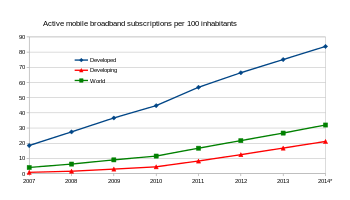
Smart watches require smart phones. Humanity has in their possession about 2 billion smart phones. Humanity owns about 3.4 billion analog phones.  You can tell this by looking at the two charts below.  The first chart shows how many smart phones have been sold - by my definition, any phone that shipped with a data connection is a smart phone.

The first image, by Chris55 - Own work, CC BY-SA 4.0, shows the number of smart phones by region per year.  In 2014, 33 % of the world had a smart phone, which is about 2 billion smart phones.
 By Chris55 - Own work, CC BY-SA 4.0, https://commons.wikimedia.org/w/index.php?curid=34939208

How many smart phones exist?


How many analog phones plus smart phones exist?

The second graph, also from Wikipedia, tells us how many mobile phones of any kind exist per year in different regions, including world-wide.  Since phones are either smart phones or analog phones, the difference tells us how many non-smart phones are around at any point in time. 

Smart phone possession is going up at 5% of the population per year, starting from a base penetration of 22 % in 2014, if this continues, everyone on earth will have a smart phone in 8 years or 2022.  Not so far away.

This means the market for smart watches will soon be everyone on the earth.  That's a pretty big market.  And smart watches depend on the most valuable thing on earth: intelligence.  We've spent more money making more intelligence per cubic inch than on almost anything else you can think of. And smart watches are only going to get smarter.  Lots of people think Moore's law which predicted that the density of processing power doubles every 2 years or so is about to expire, but it has at least another decade to go in my opinion and in Intel's (Moore's company.)

How much information can a Smart Watch send you?

First, let's talk about how well a smart phone can understand you.  A smart phone interface has about 500 - 1000 hit positions and about 10 gestures, so the bandwidth is about 5 - 10 kilobits per second (kb/s).  That bandwidth is 10 times the bandwidth of a smart watch.  It's no wonder that smart watches seem dumb compared to smart phones.  Actually they are blind, deaf and dumb.  

A smart watch screens is 10 times smaller than a smart phone's screen.  The amount of information available to a human from a smart watch is also 10 times smaller.  How much information would that be?  Screen resolutions are about 400 pixels/inch.  For a smart phone that's about a high resolution television screen, or about 2 million pixels.  Each pixel can hold about 3 bytes or 24 bits of information, so about 6  megabytes (MB) or 48 megabits (Mb) of information per screen.  Since the screen can be updated 30 times per second, the total bandwidth would be 1500 Mb/s or 300,000 times as much as your channel to it. A smart watch is 10 times smaller, and it's bandwidth is about 150 Mb/s or about 3000 times faster than the fastest analog modem made 20 years ago in the 1990's.  A smart watch can talk to you you 300,000 times faster than you can talk to it.  That might be why it spends a lot of the time doing nothing.  It's waiting for you to say something.

Why is my Smart Watch so dumb?

Actually let's first see if there is any faster way to communicate with the smart watch instead of just using gestures on the screen (which is 500 to 1000 b/s)?  You could talk to it, for instance. Speech has a total information throughput about the same as one of those modems built in the 1990's.  That would be about 56 kb/s.  You can see examples of this type of interface in Siri or on 'Okay, Google'. Today, it's like talking to an imbecile, they barely understand you most of the time and it takes them forever, but things will only get better.  Within 10 years, smart watches will understand speech at normal speeds.  Most people don't know this but computers actually understand individual spoken words better than humans today, computers understand about 95%, while humans are below 90% [citation needed].  It's the context and the gestures and the tone that humans get and computers don't. Humans have great feedback systems for communication, computers don't, but they will. It'sis just a matter of time.  When computers pass the Turing test, smart watches will too; see what Ray Kurzweil thinks.

Another alternative would be to do some type of gesture interface, but use a camera as a sensor, not a touch screen. In that case you can do more precise measurements, so you can have a much larger input bandwidth. Cameras easily do HDTV style information flows, which is similar to smart phone screens.   So it seems that the input to a smart watch will one day be as good as the output of your smartphone.  So eventually a smart watch won't be deaf, dumb and blind.  I think that will happen in about 8 years.Why do I say that?  People are willing to pay about $500 dollars for a smart phone every two years.  When smart phones are used by everyone in the whole world there will be money to pay about 24 million very smart people people to work on smart phones.  That's a lot.  They will get better. And these same people will be working on smart watches.  Granted that's not as big an industry as automobiles or furniture or energy, but it's plenty big.

Smart Watches have other problems, too.

The current batch of Android based smart watches have all of the problems of a new and cheap technology.  Instead of an analog watch that tends to wear out after a decade or two, and can only tell you a few 100 things per second, at most, and needs to be rewound every night; you get a very high bandwidth output that can emulate any known watch. A smart watch has a bandwidth of 20 to 15 million times better than an analog watch.  Even though they are cheap and crappy, they will win because they deliver more of what they end user wants for less money.  They deliver information much better than an analog watch can.  And can be programmed to deliver different information at different times. They will take over the market.

Today a smart watch is better than an analog watch, except... it runs out of power faster, it crashes randomly, it only fully works when connected to a network, it's hard to upgrade, it only works with a single type of smart phone, ...

Here's what they have to fix: 
  1. The narrow bandwidth back to the Internet.  It is interminable that this is essentially a Blue Tooth connection maxed out at about 1 Mb/s.  This is too small by a factor of at least 500.
  2. It needs to be simple to connect it to its smart phone, and the channel bandwidth between the two needs to be safe and secure and speedy.  It'd be nice if this didn't use too much energy.
  3. It shouldn't require rebooting to get something too work.
  4. It shouldn't reboot on its own at random times.
  5. It needs to use less energy or have a higher density storage mechanism.
  6. It needs to be flatter and larger so it can have a bigger screen.
  7. It needs to be able to listen and understand you.
  8. It one day needs to be able to see you, understand you and understand the surrounding environment. Hmm.  The same requirements as a self-driving-car.

Smart Watches will rule the world, someday.

Remember those 24 million smart people?  They will be working tirelessly away at making smart phones and smart watches smarter.  Today these smart watches are cheap and fairly useless. However we sell many more of them that we do of analog watches.  This just happened last year in 2015.  It's only going to get better as time goes on.  Smart phones with smart watches will take over the world, because digital is so much more useful that analog.  In fact, this has been happening in many, many industries around the world. The transition to digital has made all kinds of industries smarter.  Digital processors are the way that industry packages intelligence into machines.
How much machine intelligence is our there?  Enough to simulate a human brain?  You betcha!

How much machine intelligence do you need to emulate a human's brain?

The human brain has about one 100 billion neurons.  Each neuron can fire at around 25 Hz, and it can be connected to 1000's of other neurons.  So each neuron has about 25 kB/s of bandwidth of communication.  How many bits of information does it take to represent a neuron? Just to find a neuron takes about 40 bits.  Each neuron is connected to a 1000 other neurons, so this connectivity matrix takes about 5,000 bytes, or 5kB as us computer scientists say.  Then each neuron has some internal state to remember and some algorithm to generate pulses given the inputs, say another 5 kB. This means that you need about a million billion bytes to represent the brain (10 kB x 100 billion.) The maximum memory today's computers can hold is about 8,000 GB or 8,000 billion bytes.  Since we need a million bytes we'll need about 125 fully decked out machines to hold that neuron map. Today that memory would cost you about $8000 per machine.  So assuming there's another $2000 for everything else, you could simulate an entire brain for about $1 million dollars in hardware.

Wait, we have to check something else.  How fast can these neurons talk to each other?  Looking at our numbers above, there's about 1 billion neurons on each machine and they are sending altogether about 25,000 billion bytes of information out each second.  The fastest ethernetconnections top out at about 100 billion bytes per second.  Could I fit 256 of these in one computer?  Probably you can buy 1000 Gb ethernet adapter for $25 if they use the USB connector.  This puts us down by a factor or 10 from what we need.  So we either run the simulation 10 times slower than real life, or we split the memory up over 10 times as many computers to run it in real time.

So to simulate a human brain I need 1000 computers with 800 GB of memory each and 250 1000 Gb Ethernet connections each.  These computers are still around $10,000 each, with the memory and networking cards. So I can simulate a human brain with about $10 million of hardware.  Of course that's assuming that each neuron connects to 1000 other neurons on average, if the average is twice as high, I've got to buy twice as many computers.  And I need to have a lot of fast networking switches to keep this all working in real time.  They cost about $5000 for each computer, so they add about 50% to the cost, then I have to power and house these computers, say another $5000.  So the total costs of simulating one human brain: about $20 million.  That's today.

And this is real stuff.  This Japanese team just used one of their supercomputers to simulate one second of one percent of your brain.  They used the open source software: Neural Simulation Technology to do the simulation. The needed about a 750,000 processors, 1.4 GB of memory and it took 40 minutes.  You can easily buy 12 core chips that are smart enough to do this processing, so we would need 60 processing chips on each computer, although, these cores are smarter by a factor of at least 10 so 32 processing chips should be 4x overkill, no problem there.  Oh wait, I forgot that factor of 250 (40 minutes to one second.)  So it seems like processing power is the bottleneck.  Even though these machines can provide the networking bandwidth, it takes 60 more times cpu power then they currently have. Rats!  I either need 60 times as many machines or I run the simulation 60 times slower than real time.  60 times as many machines would mean that the investment would be 60,000 computers and cost closer to $1.2 billion dollars.  Or we need to make that simulation software algorithm 60 times faster.  For a billion dollars, I think I might put my efforts there.

How many human minds could you simulate today?

Now how many companies have 60,000 machines?  That's about the size of one large data center. Microsoft claims to have 1 million computers, and that was three years ago.  One million computers with the right networking can be used to simulate about 16 human brains.

Coincidentally, Google now sells compute engine.  For $2M per day you can get about 700,000 cores, which was what our Super computer Japanese friends were using.  That's only for the cpu cores, you have to pay more for networking. Let's guess that the networking doubles the prices.  So you can buy 40 minutes of this time (to simulate one second of a human brain) for about $100,000. That seems like a better deal that buying your own hardware and building your own data centers.  Google is rumored to have over a million computers 5 or 6 years ago.  Certainly with all the capital spending they do they have more than that today.

Think about all the computers in the world, there's about 2 billion out there today.  And I bet there's about one backend server for each one.  So that would be about 4 billion computers.  You could simulate about 70,000 human brains at the 250 slow down rate or about 250 in real time.

What does this say about the Singularity (the nerd rapture)?

Let me say that again.  Given the current number of computers on the earth, you could simulate 250 human brains in real time.  And it's only going to get faster (remember Moore's Law?)  If this continues to double every two years, computers will arguably be smarter than all of humanity in 2056 since they could simulate all of humanity at that time.

So exactly what is the Singularity?  By my definition the Singularity is already here in a bunch of places.  To me, the Singularity means the time when computers are smarter than humans at some task. Like Chess, or Go. Already happened.  Or coaching baseball.  Or coaching basketball.  The Singularity is already here in a bunch of industries: search, cedit cards, advertising, simulating rockets; the list is really, really long.  And in 2056 computers will be able to be as good as everyone in the world at everything.  If that doesn't meet the definition of the Singularity, nothing will.

Why do we call it the nerd rapture?

It's called the nerd rapture because it's basically the equivalent of the various religious raptures that ares supposed to occur at some random time in the future when God takes everyone to heaven, or some such thing where everyone is transcended.  There's one big different between the nerd rapture and religious rapture.  One of them is actually going to happen, it isn't myth, it isn't made up, it's predictable, and it's going to happen in your lifetime.  And it's going to have a big effect on the world. What effect? Who knows.  It could be nirvana or it could be hell. And it's up to you which one it is. It all depends on who you leave in charge for the next 40 years.  This could arguable be the most important turning point for humanity.  I hope we pay attention and use it for good.  Maybe we could use all that compute power to intelligently design morals instead of reading what others have said who didn't have this huge advantage.  It could give humanity a real chance to make things better in the universe.  One can only hope.

And it's only going to happen if the aliens don't get here first. In my opinion, the main reason that the aliens will be here soon.

Thanks for reading.
 -Dr. Mike


Sunday, March 6, 2016

Where are they? The aliens, I mean.

The Fermi Paradox

I've always been fascinated by the Fermi paradox.

One day in the 1940's Dr. Enrico Fermi asked his fellow physicists, "Where the hell are all the aliens?"

Sounds kind of weird doesn't it?

But, at that point in time we had just invented rockets, computers, and shown that you could make self-replicating systems.  So it's pretty obvious what we are going to do.

We are going to keep sending these robots out into space and as soon as they can do repairs, we're going to let them replicate and fill up the galaxy. (Yes, we're an exploitative bunch.)  And we will follow along shortly.

So why hasn't this happened?  Why don't we see other civilizations?  The galaxy has been around almost 15 billion years, the earth has been around only about 5 billion years.  Obviously if life can arise anywhere else but the earth, it should be already out there.  And why should we be special?  Of course life is out there.  If it's out there it's been around a long time.  If it's been around a long time it's got robots and/or colonies everywhere it wants to. So why don't we see them?

There are lots of solutions.  In fact, I've collected a bunch of speculations on this issue.  From "If the Universe Is Teeming with Aliens ... WHERE IS EVERYBODY?: Fifty Solutions to the Fermi Paradox and the Problem of Extraterrestrial Life" to SETI (Search for Extraterrestrial Intelligence) papers to Princeton astrophysicists J. R. Gott III's fascinating paper that let's you predict the time frames of anything (with little or no data.)

Some people think we're the first intelligent life in this galaxy.  Hogwash. I give that a zero percent chance.  Or that intelligent species go through a winnowing out at certain points of technology discovery (nuclear weapons, biological weapons, grey goo...) Hogwash again.  However, it's certainly possible that many civilizations are decimated by meteors if they don't invent rockets and telescopes. (Decimated like the dinosaurs were -- if you don't want to be like the dinosaurs then donate to b612 who have pledged to stop this.) This could have easily been our fate if we weren't lucky.  Maybe having Saturn out there sweeping space clean of asteroids has helped us a bit.  But surely there are other solar systems like ours that are billions of years older.  So what gives?

The solution to the Fermi Paradox

What gives is that the galaxy is really, really, really, really big. And I just don't mean big, I mean R-E-A-L-L-Y   B-I-G.  How big is it?  It's more than 100,000 light years across.  Sounds big.  But how big is a light year really?  Really, really big.  Light travels really, really fast.  Faster than anything else in the universe (as far as we know.)  That's the law.  A physical law based on Einstein's theory of special and general relativity which said that the speed of electromagnetic waves (light) is a constant (we physicists designate the speed of light by 'c' because that it is the initial letter of celeritas, the Latin word meaning speed...)  The speed of light is 300,000 kilometers per second or 180,000 miles per second.  So light gets to the moon in about two seconds. The fastest rocket (New Horizons that just went past pluto, by the way) took 3 hours (about 10,000 seconds) or so to get to the moon from the earth.  So light is 5000 times faster than the fastest rocket we've ever made.  That's really fast. The coolest way to remember the speed of light is to remember that it travels a foot in a nano-second (one billionth of a second.)  That makes it physical.

So how many feet are in a years worth of nano-seconds?  Light travels a billion feet in a second and there are about 31 million seconds in a year.  So a light year is 31 million billion feet. That's about 6,000 billion miles. The nearest star, Proxima Centauri, is 4.24 light years away.  Or 26,00 billion miles. The fastest rocket we've ever made takes over 20 centuries to get there.  More than 2,000 years.  Is it any wonder the aliens aren't here yet?

Now of course, those aliens probably have faster ships than us.  But how much faster?  It takes a lot of energy to get going faster, and it takes just as much energy to slow down.  Energy that can be used to do a lot of useful things.  It turns out that the fastest way to settle the galaxy is going to be to send out robots, then send out the genetic code of humans (or aliens) and grow them there.  That way you can bypass all that weary travel that will be so boring to everyone.  And pretty much the only way these settlements are going to be able to talk to each other is by radio or laser.  The actual physical travel between the stars just isn't that useful.  What would you trade between solar systems? Everything is way, way, way cheaper locally. The only thing you would trade would be information, which would travel at the speed of light.  Think about it. We want to put some things on Mars (like people), but nobody wants to pay to bring them back.  This goes double (uh, 26,000 billion over 300 million or 8000) times as much for the nearest star.  It would be stupid to move anything between the stars that you didn't have to. And I'm pretty sure aliens are anything but stupid.

In fact, there is no reason to travel to another star... except to annihilate any life living around that star.  In other words to have a war, or as scientists like to say: evolution in action. And you wouldn't bother to send living things, killer robots can take care of it.  Even Stephen Hawkings know this to be true. Although he's kind of late to the game since we've already broadcasted our presence to every alien out there... well, not quite.  We've only been broadcasting electromagnetic signals for 60 years or so.  This has consequences, which I'll talk about in a minute.  But first...

There is no paradox, we've just been lucky... so far

If you think about this, it's obvious why we don't see any aliens out there.  Some other alien race saw them first and took care of them, either slavery, assimilation, reservationed or annihilated.  And the alien race that was first is very careful to keep very quiet and watch everywhere so that it doesn't risk having the same thing done to it.  (Thank GOD the galaxies are even further apart, that means we don't really have to worry about intergalactic war any time soon.)  But why haven't the aliens already been here and taken care of us?

Like I said, it's a really, really big universe.  They just aren't here yet.  It's obvious that they've got robots watching us, that'd be relatively cheap, but they wouldn't want to create a possible rival race, so these robots aren't going to do anything on their own (like turn on their masters.)  So, the alien robots are waiting, probably out by the Oort cloud. They've sent signals home and are waiting for orders.  So the orders from the aliens would only be here if they were closer than 30 light years.

There are only 133 stars that are within 50 light years of the earth.  There's probably a very small chance that one of these is settled by the master alien race that can decide to annihilate the earth; and then again, why would the aliens bother?  We aren't going to be a threat to an alien planet for a long, long time. There's no hurry.  Do you think aliens are afraid of our puny nuclear bombs?  How does a nuclear bomb compare to the sun?  The sun puts out the equivalent of a trillion nuclear bombs every second. I don't think a race that has been sentient for millions (if not billions) of years is very concerned that we might harm it somehow.  It's also obvious it could hide as well as it wants to (look at how far our primitive cloaking technology has already come.)

However, this progenitor alien race does need to act at some time to protect itself.  Now when would that most likely be?  It's going to be at least as fast as light can travel back and forth across the galaxy, which we know is <200,000 years, just because no matter where they are hiding, the signal that says 'humans are now a threat' is going to reach them by then and they can respond.

In fact, we can write an equation that, given the density (number) of alien settlements in the galaxy, will predict how soon the aliens will be able to respond to us.

First we assume that the number of settlements the aliens have in this galaxy is N.  How many stars have they bothered to settle?  It turns out to be a very lonely thing to settle stars (as discussed above.) My guess is that N turns out to be a small number.  They'll pick the safest, most stable stars to settle around.  No point in having your civilization annihilated in a supernovae, so they will spread out, but no reason to go every where when you can build your own planets where ever you want.  Let's calculate the minimum N would have to be if the aliens were going to tell their robots to talk to us tomorrow.

There would have to be at least one settled star within 30-50 light years of us.  As mentioned before, this is about 133 stars.  So if one of these stars was settled that would be ~1% of the stars would be settled.  That means that N would be 1% of all the stars in the galaxy and since there are about 100 billion stars in the galaxy, N, the number of settled stars, would be 1 billion stars.  Now that seems pretty wasteful.  In fact, they've probably settled just enough stars to be close enough to everywhere in the galaxy to 'take care' of new intelligent races and protect themselves.  How close do they need to be?  How long can they risk us developing technology before we become a risk to them?

Those dang Killer Robots

What's the worse scenario?  Killer robots, of course.  That's always the worst scenario.  There's a chance we might be stupid enough to make killer robots that can reproduce and continue to evolve their technology and killing abilities.  (Okay, that's sort of what we are, but we're not quite repairable enough to matter, but... it's probably about the same amount of time to make our lifetimes be long enough to be a threat, so we can do the calculation twice to see if we get comparable answers.)

How long would it take to make killer robots that can reproduce themselves?  Well, Ray Kurzweil thinks it's going to happen in about 25 years.  Paul Allen thinks we will still be waiting for the singularity 85 years from now.  Over 80% of the things Ray predicted have come true, on time. Nothing that Paul Allen has said will come true has ever come true. (I can give some very personal examples if you want me to.)

And let's remember what we are trying to estimate here: How long from the invention of radio will a species be able to invent killer robots?  Remember, this is an existential threat to aliens, they don't want to get it wrong.  "Rats, was that a killer robot that just passed me? Dang, if I had just annihilated the human race a year earlier we wouldn't all have to die.  Sorry about that, honey.  I'll try harder next time."  So they are going to be very, very conservative.  Cripes! I'm starting to scare myself.

Let's just assume, for sanity's sake, that Ray is crazy optimistic.  So radios to killer robots takes at least 150 years. Shoot. The aliens would want to put small settlements within 75 light years of everywhere. Rats. I guess they do need to have 25 billion stars settled.  Or at least that many outposts, maybe not that many settled stars.  Get ready to kiss your ass goodbye.

Predictions

So this makes a few predictions that we can test.  We could look for alien robots watching the solar system.  How can we do that?  That's another blog post, but the easiest thing would be to set up a huge radio telescope looking back towards the sun from far away.  That way we could detect anything the robots were sending out.  Sounds like a great project for the first killer robots we make. And it's not even out of bounds for current technology, just expensive.  And we could use the telescope to look at everything else in the galaxy with very fine detail.  A worthwhile project all around.

Second, this line of reasoning predicts that we will be contacted by aliens before the singularity. Since that's going to be around 2045... they should be here any minute.  There's a few other lines of reasoning that say the same thing, but that's another blog post (how can you predict the lifetime of something you find at random? Or why are you alive now and not in the future?)

So, sorry to be such a downer, but despite Stephen Hawking's best intentions, it's already too late to change this.  The aliens will be here and it will most likely be within your lifetime.  I'm not sure how to get ready for THAT, except that it's another blog post...

First Killer Robots


Here's a picture of the first killer robot: automated radar guided gatling gun to shoot down jets. Installed on the Missouri battleship during Reagan's presidency.  Looks frighteningly like a dalek, doesn't it?

Thanks for reading!
 -Dr. Mike


Tuesday, February 23, 2016

When can I buy the Millennium Falcon?

Obsession

I am obsessed with rocket ships. (Why? Because Trump might be the President of the US, and I don't want to be here at that point.)  My hero is Elon Musk (read about his latest adventures in the wait but why blog, by Tim Urban, another one of my heroes!)  Why am I obsessed with rocket ships? Because that's the only way to save your ass when the sh*t relay hits the fan. Some day, when we have an intergalactic civilization, it will be obvious when you have to leave a planet because crazy people are taking over, with a spaceship you can actually do it. Today, not so much.

How Much Can I Pay?

So, when can I buy the Millennium Falcon?  Okay, not me specifically, but someone in my situation. Let's assume you are in the top one percent of the US economy. And let's assume that the economy grows  at 3 percent per year (okay, aggessive but not unbelievable.)  So how much money am I making every year?  According to CNN I should be making $400,00 in 2010 to be in the top 1%.  So assume I want to buy an Recreational Vehicle (the Millennium Falcon is the coolest RV ever, but WTF, going for the win.)  $800,000 in the year 2040 and $1.6 Million in 2064.  A 3 % growth rate means it doubles every 24 years.

How Much Would it Cost?

So how much would the Millennium Falcon cost today?    The Apollo moon landing cost about $12 Billion per launch (in todays dollars) and took place in 1970.  A shuttle launch took about $450 Million in 2010. Today, just to get to low  earth orbit costs $70 million per launch, which is a lot. And Elon has promised to drop it to $500,000 in 2040 to get people to Mars.  If you average those numbers out, it's a fairly steady 12.3% improvement per year.  Not bad.  That means the cost comes done by half every 6 years.

Can I Afford it?

Now let's assume that I'm going to live in the Millenium Falcon, so I can afford to finance it like I do a house, over 30 years, using 25 % of my income (if you live in CA, this will sound familiar.)  So, at a 3 % interest rate I can finance about $5,000,000 in 2040 (10x the trip cost.)  So, it might not be the Millennium Falcon, but certainly you could finance some type of space station vehicle.  Space front property.  Not sure if we'll have faster than light travel (the Alcubierre warp drive might take a little longer to get the kinks out of it) but the ship will be able to take off and land.  Good enough for me. I declare a win.

And Where Can We Go?

And here's where the Millennium Falcon can take you: On the grand tour, and further.
But what we're really aiming for is to have Burning Man on Mars.
So that takes a little bit more effort, but 2040 seems like a great goal!

Photo

Thanks for reading.
 -Dr. Mike

Saturday, February 13, 2016

Grand Vacations or Burning Man on Mars. It could happen.


Precursors
No, it will happen. At least if the aliens don't get here first. But we'll talk about that in another blog post.

What I want to talk about today is the mistaken idea that progress will end. There's a neat book by John Brockman, actually a series of books that I call 'blog fodder.' The one that drove me to write about Grand Vacations is: "This Idea Must Die: Scientific Theories that are Blocking Progress." John has put together several books of this type where he asks scientists, economists and others to write something provocative on his chosen topic. These books are great fun to scan. Many of the articles are great fun, many are just crazy, some are so bad they aren't even wrong (as Wolfgang Pauli would say.)

The article that started my train of thought that has led to this blog post was: "Economic Growth." Cesar Hidalgo, an Associate Professor at MIT claims the idea of economic growth must die. He makes two arguments: 1) the idea is recent (this century) and 2) the idea is absurd. Both arguments fall into the 'not even wrong' category. Here's why he thinks economic growth is absurd: If growth rates continued at 1% per year, in a thousand years the average American would make $1.1 billion in the year 3014. Yeah. So what. Some people in America make more than that today.

But really, it's not about the money it's about the capabilities. And in the year 3014 the average American will have more capabilities than the average billionaire has today. Can the average billionaire take a vacation on Mars? Not today (although several are trying.) But in 3014 the average American should be able to. Think about what the average person could do a thousand years ago: walk, shout and listen. Not a lot. A thousand years later we have cars, jets, spaceships, mobile phones, the internet, computers and electricity. Things change.


Grand Vacations
What Grand Vacations are available today and how do they compare to the past?

Circumnavigation of the Globe
One Grand Vacation available today is a trip around the world. Robert Heinlein did it and wrote about it in the early 1950's. Today you can take the Queen Mary II on an around the world trip (the Cunard line actually has three ships circumnavigating the globe continuously.) The first people to ever sail all the way around the world were some crew members on Ferdinand Magellan's ships in the years 1519-1521. Five hundred years ago. First time ever to routine in half a thousand years. Things change.

How else can you circumnavigate the world? There are several jet based vacations: one by the National Geographic Society, one by Four Seasons, one by Abercombie & Kent, one by the Smithsonian Society, and the list goes on. What was science fiction 150 years ago is now common. SkyTeam will even let you set up your own itinerary. The globe has even be circumnavigated via hot air balloon. And Google is managing a fleet of balloons to provide world-wide Internet coverage. So don't tell me that things don't change.
Retracing the Most Famous Circumnavigation: Darwin's Voyage
Darwin wrote about the voyage of the Beagle (where he got the idea and lots of evidence for evolution) in 1839. He ended up circumnavigating the globe in 5 years (it was supposed to only take 2! Oops). The book became a popular travelogue in England and around the world. The first version only had 1500 copies printed, but it hasn't been out of print since and you can find several web versions. You can find a tour that recreates parts of the voyage from Australis, several others are mentioned here. Or you can recreate parts of the trip on your own.
Space Trips
What other Grand Vacations are available? Space Tourism surely qualifies. NASA has commissioned a set of posters that would tickle any explorer's heart. Space Tourism has actually started, Mark Shuttleworth and six others have been on Grand Vacations via Space Adventures. Several companies are working on sub-orbital adventures: Virgin Galactic, XCOR Space Expeditions, Blue Origin, are building spaceships and SpaceX offers flights you could book now. Remember that the first person in space was Yuri Gagarin in 1961, less than 60 years ago. Most people don't know it, but humanity has had at least one space station orbiting the earth since 1974.  So you might try to get there.


For those just interested in weightlessness there's a company providing that service: zero g. And there's an awesome rock band (OK Go) that used the zero-g jet in a music video. See more of their stuff on YouTube.

Safaris
There are many ways to go glamping. But obviously the best is an African safari.  Safaris are a veritable industry.  They used to be about big game hunting, but now they are mostly about photo ops.  Still, what could be better than a trip to the wilds of Africa, back to the cradle of humanity? I would recommend a safari break in the middle of your circumnavigation. That's what I'm planning on doing.

Festivals
There are hundreds of music festivals in the US. Some of the local ones are Montery Jazz and Coachella. A popular one is SXSW which mixes music, film and interactive exhibits. Then there are Art Fairs around the world and in the US.  You could spend your entire life going from one fair to the next. Then there are food festivals: the most famous (at least if you like beer or are German, like me) is OctoberFest in Germany. Don't forget the county fairs, here's the ones in CA. But every state has them.

Burning Man
Arguably the most famous and eclectic anti-festival of them all is Burning Man. Burning Man takes some effort to get to, but nobody said these vacations have to be easy! I can't wait until we have a Burning Man on Mars. It would be a long vacation.  It takes about 3 months to get to Mars. When could it happen? How could you do it safely? That's another blog post.

Invitation Only
Then there are those invitation only vacations: DavosTED or the Bohemian Grove.

Theme Vacations
You can have a Grand Vacation by setting up a theme.  Some popular themes are baseball, unique museums, science museums, art museums, design museumsamazing buildings, tallest buildings, highest mountains, beautiful ports, longest train routes, Or you could drive one of the longest roads in the world or the steepest roads or the windiest roads or the craziest roads or the most fun roads to drive. Or you could go for beauty.  Or World Heritage sites, there are thousands of them, so there's always one nearby.  Or you could do an archeaological dig or visit ancient ruins. Or the best dive bars in every state.

Or visit all the Disney parks.  My family is in the process of doing this.  We've already been to Disneyland, DisneyWorld, and the parks in Tokyo and France.

One of my favorite dream vacations: visit all the major wine regions in the world.

And my second favorite dream vacation: Michelin starred restaurants.

Or you could follow a book, one that comes to mind is: Huckleberry Finn or pick an epic road trip from some other book (like Mark Twain's Roughing It, a tale of cross continental travel before it was easy.)

Or you could follow your favorite band, mine being either the Beatles or The Talking Heads.  If only they would tour again.

Or think up your own theme: best kite surfing beaches, movie scene locations or famous graves.

Thanks for reading.
 -Dr. Mike


Wednesday, February 10, 2016

What is it good for?


Welcome to the WIIGF blog: "What's it good for?", the question I like to ask whenever I learn something new.  And I love to learn new things, you might say learning is my passion.

What have I learned this year?  I learned I had cancer.  That'll clear your mind out pretty quickly. Don't worry though, it wasn't life threatening, but it wasn't fun. Actually it was kind of fun. It got me to think about what I really want to do in this world.  And write was one of those things I decided I wanted to do, so here I am.

Unlike my buddy, Don, I'm not quite ready to retire.  I see a huge need to help all kinds of organizations get into the Cloud (with a capital 'C') and improve the world.  So I'm working in Google's Cloud division, doing what I can to help our customers every day. I love working with good people and I've stuck with Google longer than any other job I've ever had, and I plan to stick around a bit longer.  Time flies when you're having fun!

This blog is ostensibly about  how to use the scientific method to study people.

I know it's stupid.

You can't possibly predict how people are going to react to something using the scientific method, unless you do double-blind studies (something I'll blog about later.)  I'm not talking about that.

What I'm talking about is a way to prove that Free Will (with a capital F and a capital W) exist.

Philosophers have convinced themselves it doesn't.  They think we are all zombies.  And why do they come to this conclusion?  Because they don't understand physics, they don't understand Shannon's laws and they don't understand Newton's law. I have very little respect for philosophers. And that'll be another blog post.

One of the other things that I'll be blathering about is music.  I've always loved music, I abandoned it in High School (marching band wasn't cool enough), picked it back up in college, then have basically ignored it since then.  And when I say music, I don't mean the passive kind.  Anyone can listen to music.  I mean the active, play it or dance to it kind. I'm going to get back into music again.  First goal: continue learning how to play piano.  Second goal: Live performances. Third goal: something to blog about.

What other things do I find interesting?  Well, you'll just have to listen to me blather about baseball, the American sport. Really it's the sport of nerds.  Baseball is unique in that every play involves just you and the ball.  So everything can be measured.  The measurements are noisy, but predictive.  I've got a whole host of baseball oddities to talk about. (Did you know that players that have tall socks and short pants get fewer low strikes called against them?  Well neither did I, but I'm going to go through the statistics and find out if it's true.)

I've spent a long career in programming, having taken only one programming class in my entire life before I was 50.  After 50 I've take several classes for fun.  So I'm also one of those self-taught programmers who stumbled on the field and could never leave it.  Software is eating the world. And I'll explain why.  And education is at a turning point.  It's going to change a whole lot in the near future, and I know which direction it's going to go.

And I expect to blog about some of the things I've learned over the past few years (I've already talked about sabremetrics - the mathematics of baseball.)  But I've also taken courses on quantum computing and seen some of the most interesting attempts at building quantum computers at my alma mater, the university that granted the first Ph.D. in physics: Yale.  (That happens to be the degree that I stumbled into.)  And I've taken classes in machine learning and I've taken Stanford's physics classes for nerds (as an undergraduate and an old fogie.)  And I'll talk about my favorite professor, Leonard Susskind - who teaches  the class 'Theoretical Minimum' and who's been battling Steven Hawkings for years (and who's right, by the way, and I can prove it.)

I've also turned into a political junky in my old age so I'll blather about that for some time.  Some things about US politics have actually been empirically determined.  Neither party wants you to know about it, but I'll blab about it for several posts.

And I've become somewhat of a foodie and a winie (is that even a word?) so you'll hear about that as well.  

And charities.  Some charities really make a difference in this world. And some don't. I'll give you my opinion on why that is.

And space.  Actually our exploration of space.  It's a lot more interesting than you can imagine.  I'm a child of the space race - I was born one month before the first satellite left the atmosphere and I hope to die after I've seen us set foot on Mars.  That's definitely worth a series of blog posts.

Speaking of space, where the hell are those aliens?  Can we use the fact that we haven't seen any to predict how many advanced civilizations are out there? Yes we can! We can use the famous Drake equation to put limits on the density of alien civilizations in our galaxy.  The seminal work on this topic is from one of my favorite opinionated bloggers: David Brin.  He's one of the premier science fiction writers of the century (read some of his Uplift War series to find out why) and he's a weird mixture of libertarian, conservative, sousvelliance, civil war nut, and fun to read.

Some other stuff I won't be able to resist blogging about include religion, ethics, morality, genetics, information technology, artificial intelligence and particularly the singularity.  I can make a pretty good case that the singularity (or as us Geeks like to call it: the nerd rapture) is already here and people just haven't noticed.  Definitely something to look forward (or back) to!

What I won't do is make stuff up.  Everything I blog about will be true, to the best of my knowledge.  I'll never say something just to be provocative, unless it's true.  I'll show you how to recognize truthiness, how to make up your own mind, how to recognize outright lies, and how to think for yourself.  It's the least I can do.

You can follow my bluesky posts if you want to know what I'm thinking.  There I try to post about things that matter to Geeks.  Physics results. Space launches. Artificial intelligence.  Fun facts. I always try to instill that sense of wonder in everyone, just like one of my heroes: Neil deGrasse Tyson.  If people would just keep that sense of wonder, that ability to ask why, that stubborn tendency to question authority, we'd be much better off.

Finally, some of the other topics I will be turning to in later blog posts include: taxes: why are they good for you?  Reading: is it good for you?  Writing: why can't everyone write?  Nutrition: why don't we know what's good for you?  Genetically modified food: is it good for you? Sports: what are they good for?  Are cars really robots?  Will the TV and cable industries fade away?  Will print die? Who does the best reporting that's based on facts? (Nate Silver makes a decent argument, every day.) The concept of God: what's it good for?  Religion: what is it good for?  The US Constitution and the Declaration of Independence: what are they good for?  What do they really say? The French: what are they good for?  Technology: how does it evolve and where is it going? And whatever else happens to be on my mind when I sit down to write.

Here's hoping I can keep some small set of people entertained, informed and learning new things every week.  See you soon!
Thanks for reading!
 -Dr. Mike


This post was unpublished because it violates Blogger Community Guidelines. To republish, please update the content to adhere to guidelines.

"Your content has violated our Malware and Viruses policy."

Bullshit, blogger.com, bullshit.

I read the guidelines. No violations. Your automated systems appear to have failed, again.


The Effect of Electricity on the Average Level of Services and Accouterments Delivered to Britons.

In this piece we take a single drawing-room scene from Dickens's " Bleak House," a wealthy Victorian's parlor at the heig...