Monday, April 13, 2020

Wall St. Journal nails it again! Never listen to the their opinion pages unless you want to see billionaires begging.

Wall St. Journal nails it again! Never listen to the their opinion pages unless you want to see billionaires begging.

I've only agreed with three @WSJ opinion pieces in 60 years. Two have come out around the failed Trump presidency. I forget the other one. Just this morning they failed big time again. The WSJ published a hit piece on the Democratic Party and Joe:

Joe Biden and the Slow Death of Liberalism

Democrats are again choosing a moribund ideology bereft of new ideas. Radicalism beckons.


Wherein  complains that Democrats forsook the radicals and chose the candidate with the most likely chance to beat Trump. I guess because if they had chosen Bernie Trump had a better chance of winning?

The slow death he complains about is that Liberalism has 'nothing new' and is 'rehashing old ideas'. 

Like Medicare for All. And he is correct. The Republicans have been able to kill this idea in our checks and balances government for 90 years. That wall of hate is showing cracks, though. See Obama's and Nancy Pelosi's ability to push through the Affordable Care Act that added 20 million Americans to the healthcare system. The Republicans have been trying to dismantle this healthcare system for ten years and failed. It's here to stay. And expansion of the ability of government to meet it's deftly stated needs in the Declaration of Independence (Equality for All, Life, Liberty and the Pursuit of Happiness) continue unabated. The American healthcare system is currently the most expensive system on the planet. It is also one of the most inefficient, cruel and byzantine systems imaginable and delivers the worst results. Claiming to be market driven with no market pricing. Monopolized with no regulation that is meaningful in managing costs. That's about to change. 

Why is the Republican party the failed conglomeration of conspiracy theories and billionaires?

When one party fights to the death to restrict government from fulfilling its first and founding pledge:

"We hold these truths to be self-evident, that all men are created equal, that they are endowed by their Creator with certain unalienable Rights, that among these are Life, Liberty and the pursuit of Happiness.--That to secure these rights, Governments are instituted among Men, deriving their just powers from the consent of the governed,"

that party slowly loses legitimacy in the eyes of the American people and must resort to raw illiberal power: gerrymandering, voter suppression and identity politics: white supremacy. This Grand Old Party has no legitimacy, so to survive it becomes beholden to the highest bidders, the death merchants, to have any chance to stay in power. The GOP is no longer conservative. It has been taken over by the Tea Party, the "kill government" radicals that want to reinstate feudalism. They have sold their souls to the billionaires and the billionaires have brought the party to heel.

What are the fundamental tenets of today's Republican party? There are two types of tenets, those that support white identity politics and those that support the billionaires. Let's look at each of them in turn. Then we will compare them with what the Democratic Progressive Party is based on. The difference is as clear as night and day. One party is the party of death, the other party celebrates Life, Liberty and the pursuit of Happiness. The differences couldn't be more stark.

White identity politics is about to fail spectacularly. #BankruptcyOrDeath is not a healthcare policy.

White identity politics. What does this mean? It means supporting the wedge issues of the mainly white upper middle class and dragging the uneducated along with them for the ride. It means punishing minorities and the poor whites themselves to show that nobody deserves a helping hand. I've got mine, so fuck you. What are the white identity wedge issues? Abortion. Faux-Christianity. Guns. Poor people are morally unfit and must be punished and incarcerated. Keeping power. Ensuring that whites get what they want or nobody does. And they've settled on the nobody side of the issues for the last 150 years. It took a Great Depression to instil a safety net. It took a Great Recession to advance universal healthcare. The last thing the Republicans want to admit is that they are a minority in America. They've been in charge forever and resisted every sharing of power with all their might. When my grandmother was old enough to vote she couldn't because white men resisted universal suffrage. Just like they resisted allowing blacks to be citizens. Just like they instituted Jim Crow laws that made apartheid legal in the US. Just as they continue to gerrymander districts to ensure that they have legislative majorities with a minority of the vote. One man one vote is anathema to White Identity Politics and the GOP has embraced WIP.

Who are the most ardent supporters of the GOP? Evangelical Christians. Why have the Republicans embraced the wacky ideas these mostly white religious fanatics have been pushing? Yep, they're white. No other party would even consider these crazy things as viable options, but the GOP is in it for the sheer numbers. They also embrace the Nazis, the fascists, the white supremacists, the rapture enablers, the faux moralists, the supporters of Royalty and the white Russian oligarchs. Is there anything white that the Republicans wouldn't support? Nope. This leads to an incredibly convoluted platform that's really just an amalgamation of hateful spite and intellectual bullshit. 

What does this cause them to support? RealityTV stars that lie and manufacture truth, because there is no there there. The only universal truth they can agree on is "hate those different than us and punish them." Hate the gays. Hate the Jews. Hate the immigrants. Hate minorities. Hate liberals. Hate other countries. Hate the muslims. Hate other religions. Hate the experts. Hate anyone who doesn't show fealty to our King. Hate anyone who doesn't fall in line with the lies and conspiracy theories. Don't fraternize with the opposition. It's our way or no way. Hate the government. Destroy it when given a chance. Forget compromise. How can you compromise with those who aren't human white Republicans? The vermin need to be punished, incarcerated, held in concentration camps, deported, deprived of life, liberty and the pursuit of happiness. It's an evil philosophy. It cherry picks passages from a bronze age book of fairy tales to create a selfish might-makes-right feudal philosophy of what I call speciesism.  They are attempting to create a new species of humans that don't include anyone but their white identity in-group. It really is a #DeathCult and Trump is the perfect leader.

So they embrace the wedge issues: abortion is okay for me, but not for you. Guns are okay for me but not for you. My religion is the truth, yours is evil. You must follow my made up morality. You can't force me to treat everyone equally. The only reason for government is to support my religion and build an armed service to protect me from you and those other foreigners. Anything else the government does must be torn down. There is no room for collective action. It's every man for himself. I'll help my fellow white privileged neighbors in my town, but fuck those assholes in the big city. They're filthy vermin sucking the life blood out of the country and they can just stop pretending to be Americans and go back to their failed countries and die. Most of them revel in this attitude of "owning the libs" because they have no moral basis for their lives, it's just a game they are trying to win. They feel secure in their white privilege so they don't give a shit that others are suffering and need help. The poor and suffering must be in that state through a moral failing, not a systemic abuse from those in power? No way. We're cruel, but not that cruel. There's no racism anymore. Black lives don't matter, everyone's lives matter. It's a story they tell themselves because to admit the truth would be devastating. They say they have no privilege. They have achieved everything through hard work and good morals. They deserve what they have. They are good because they are rich. You are evil because you are poor. How else to justify their policies?

What to do when your White identity is no longer the majority?

The problem is that these policies are only supported by a minority of the population. How can you make a party that stays in power with a minority of the voters? You can't. Unless you cheat. Unless you sell your souls to the highest bidders. So of course, that's what they have done. They've sold their party to the billionaire led resource extraction sectors of the economy. What ideologies does the Republican Party support that white supremacists really don't give a shit about? Low taxes on high incomes & unfettered capitalism. Even the Republican base supports higher marginal tax rates on millionaires & billionaires. But not the Republican Party. Why? Because these millionaires and billionaires finance the party. The members just have to suck it up and give their money away to make the economy more unequal. Rich is good, only Congressman get free money from donors, the unwashed masses have to get their own. 

Unfettered capitalism leads to a whole slew of sins. Markets are the ultimate arbiters of what is moral and right. Monopolies are good. What's good for Exxon is good for the country. Thus the support of coal and other fossil fuels. Never mind that coal kills more people each year than there are workers in the industry. Some billionaire extracts the profits and shares some of those profits as donations with the Republican Party ... so it must be okay. Same for oil. Who cares if it will burn the earth to a crisp? That's tomorrow's problem, today they are paying me to lie about it. Same thing for farmers, tobacco farmers, not farmers actually, but immoral corporations. Cigarettes don't cause cancer, people do. Opioids aren't addictive, people need them to fend off the pain of their failed lives, their lack of meaningful work, their polluted landscapes, their putrid food and their poor healthcare. But so what? The immoral companies give us money, the morally bereft poor don't give congressman anything, except their vote if they can be hoodwinked into it!  Being poor is a sin; it's your fault! We'll support your hate on the others that have caused you to be poor, but we aren't going to do anything about it. Unless you happen to be a large farm conglomerate. Then we can subsidize you, not your workers, to the tune of billions of dollars. And don't forget to donate some small portion of that graft back to us. We'll give you trillions in tax breaks, all we ask is for a measly billion or so in donations.

How can this morally bankrupt system be fixed?

It really is a morally bankrupt system. And it won't be fixed until the party finance system is changed. Which is why it's important to support HR#1, the bill to fix this dark money, hidden finance system that takes away the votes of Americans and substitutes it with the donations of billionaires. But that's another blog post for another day. That's why the "billionaire tears" campaign of Elizabeth Warren was so powerful (raise marginal tax rates on the rich so they pay their fair share and tax all property, not just housing.) Even Republican voters can see the sense of this proposal. She would make an excellent VP. She would grab the suburban women's vote out from under the Republican hate mongering subservient culture and deliver it to the Democrats. It would be a landslide. 

Why does the Wall St. Journal care about this stuff?

This leads us into refuting the main point of the heinous hit piece in the WSJ claiming that Joe Biden has no platform and is just rehashing old failed Democratic policies. First remember that the WSJ is an immoral corporation. It is run by a foreign billionaire. The same one that runs Fox News. Whereas on Fox News they just spew conspiracy theories and hate on the out groups, the WSJ must actually report facts about corporations, not about what they do or the harm they cause but about the money they are or are not making. They limit the bullshit and hate spewing to the their editorial pages and their think pieces. It's all from the same script though. They need to paint the Democratic progressive agenda as communism. They have no choice. They want unfettered capitalism. They want monopolies. It's the American dream! I may grow up to be a big corporation that can spew my costs upon the unwashed masses and extract billions! And I want the government to help me extract what's rightfully mine from those stupid Americans. It's harsh capitalism for the masses and government socialism for the corporations. 

Old, failed policies? Nope, regardless of which party Americans are in, it's the policies they want!  That's what scares the WSJ: Americans want Universal Healthcare.

What are these old, failed policies that Democrats have been pushing? Universal healthcare has been a long standing plank in the Democratic platform. Starting with FDR and the New Deal. He could only get Medicare for the aged passed, unemployment insurance and welfare for the poor. And that took a Great Depression. Harry Truman tried to extend it and failed. JFK tried to extend it and failed. Lyndon Johnson, the master politician of the ages, managed to pass the civil rights act and the war on poverty, greatly expanding the safety net and finally putting to rest the question of separate but equal. Clinton tried to improve health care, but lost by one bribed vote. Obama and Pelosi managed to pass the Affordable Care Act by one vote. In addition to providing subsidized health care it also expanded Medicare for the poor to the states. Joe is doubling down on this policy. Joe is proposing to lower the age for Medicare to 60, the exact opposite direction that the Republican Party is screaming for. The majority of the Democratic Party wants a public option but is afraid of the Medicare for All option implemented in the rest of the world because it would be hard to satisfy all the special interests (even though the current system is still the most expensive and least effective system in the developed world.) The Republicans can always pitch a change as scary and make up reasons for people to hate it. The Democrats will settle for moving the needle forward every cycle until, poof!, Medicare for All is actually here. 

Regardless of which party they are in, Americans want billionaires to pay their fair share. 

What's another of the old, failed policies the Democrats are pushing? Having billionaires pay their fair share. Higher marginal tax rates. Taxes on all property, not just housing. This scares the hell out of billionaires, so the WSJ must absolutely throw every dirty trick and bullshit argument against it. It's a matter of life and luxury. However, if you want to minimize middle class taxes, you must maximize billionaire wealth extraction. The middle class is all for this, the billionaires have been waging class warfare on the poor for aeons. The poor have nothing more to be extracted, so the billionaires have moved onto the middle class and the middle class sees it plainly and clearly. They saw the billionaires command the Republican party and defy 80% of the American people to pass their last tax scam. They pretended to give the middle class tax breaks - but those breaks expire in a few years. The billionaire tax breaks and the taxes on corporations are permanent, until the Democrats can get control of the Senate. Then poof! the maximum resource extraction will begin. 

The United States has turned into the largest tax haven in the world. If the billionaires want to keep that status they are going to have to pay their fair share of the tax burden. When was the growth in productivity and the economy the highest? It's directly correlated to the marginal tax rate on the rich. The more the government takes the harder the billionaires have to work to support their luxuries. And they respond well to financial incentives. There have been several theoretical papers that have pegged the maximum extraction marginal tax rate to be between 70 % and 85 %. The current effective rate is below 25 %. This will change. And corporations aren't people, corporations are immoral slow artificial intelligences out to maximize their profit. They can respond to the higher marginal tax rates, and they already do with financial shenanigans that have nothing to do with real capital and investment and everything to do with tax avoidance. So nobody has any love lost for the corporate tax rate on the Democratic side. 

 The billionaires have been winning the class war for the last fifty years. The inequality is beyond anything seen since the Great Depression. This current Great Decimation will put an end to that. If they want to stay in the United States and be protected by Americans, the billionaire class is going to pay. And they aren't going to dictate the laws anymore either, it's going to be a negotiation. One man, one vote. Donations are public knowledge. Lying and conspiracy theories will be evident to all. This is the point of HR#1 (another blog post on another day.) And all of the Democrats have signed on. Things are going to change. 

Sharing the burden of an educated society leads to high productivity and a growing economy.

What else do the Democrats want to change? They want the millennials and generation X and Z out of the debt that the billionaires and their parents should have covered (like the boomers covered the GI bills) but haven't. There is no reason that education shouldn't be a public good with shared costs through taxation of everyone as they reap the shared benefit of an educated population. You can't run the world with a bunch of high school dropouts, no matter how hard you try. You need a well educated body politic. The Republicans hate this because it makes it harder to bullshit their voters. If the voters can't understand logical arguments, they're much easier to fool. Trump loves the uneducated because they believe his bullshit, even as it changes minute to minute. When you don't exercise your reasoning ability you lose it. So it's for the good of society that we support universal education with shared costs. The more productive economy will gladly pay for their kids' educations in the future, There's no reason that the younger generation has to pay for their own education and their kids' education. That's just rich old white people being selfish again. Taking from their parents and making their children pay for themselves. It's a selfish policy and it will end.

Inequality is a bad idea.

The other "old, tired and failed" policy is that all men are created equal. No discrimination on the basis of sex, race, gender, orientation, religion, immigration status, or political party. It's going to be a fair fight all around. No gerrymandering. No voter suppression. No illiberal democracy. No fascism. No favoritism. No inequality. The laws will respect the people's will not the billionaires pocket books. This is HR#1 which eliminates the purchasing of politicians and the corruption of money. This will be the hardest change for the Republican Party to accept, if not for money, gerrymandering and voter suppression they will never have a majority with their current platform again. They will change or they will be relegated to the dustbin of history. 

What other progressive ideas do the Democrats support?

What else does the Democratic Party stand for? Higher minimum wage. Paid health leave and parental leave. Subsidized pre-school and day care. Taking care of the earth (which means ending fossil fuel subsidies and carbon emissions.) Continued expansion of civil rights (all men are created equal.)  Gun control - no you can't have weapons of war in your house. Ending cruel and unusual punishments. Right to privacy, including decriminalization of drugs and reparations for past incarcerations. Women in control of their own bodies, subsidized birth control and abortions. And finally the support of these rights to the world. Cooperating with democratic regimes and undermining autocratic regimes. 

The differences couldn't be more stark. One party fundamentally supports the American exceptionalism, the other party is bought and sold by a small group of oligarchs. The battle will be fierce, it will be long, but it will be won.

 Thanks for reading,
 -DrMike


Wednesday, January 22, 2020

Is the Medium the message? Touch-Tones(TM) on the iPhone say no, at least not yet.

No. The medium can influence the message, but only after people die.

Mimesis: the tendency of new forms of information to mimic old forms of information.
Then, as the oldsters die off, the medium takes over.

I'm taking a fascinating class at Stanford Continuing Studies: "The History of Information" (Beyond Bits and Bytes) taught by Thomas S. Mullaney (Professor of History.)

Professor Mullaney is teaching us about how information is put "in formation" by different technologies. How those technologies govern how the information is transformed ("transformation") and how it starts out always the same, but eventually the medium wins out and takes over what can be done. The Gutenberg bible looks like it was written by a scribe. Why is that?

Tonight's lecture was particularly interesting. And one concept was a real shock to me. I've read Marshall Mcluhan's book: "The Medium is the Message" (a really fun book) but never really got the point. Tonight I believe I finally understood what Marshall was blathering about.  It only took one picture to explain it to me.  Professor Mullaney put up a picture of the original iPhone dial screen and asked "Why do the keys send out Touch-Tones? They are obviously worthless in terms of an actual telephone call, and they have no current practical use except to annoy you - how do you turn them off?"

Wow. It really hit me. Apple, the experts at user interface, had just mimicked the last generation desk phone technology into a device that had no need for it, no desire for it, actually diminished the usefulness of the device. Why? Why would Apple do this? Is it because they want the experience to be as unchanged as possible, to be as 'comfortable' as possible to those users who owned the previous technology? It must be so, as there is no other reason to annoy everyone else without some payoff.

A long time ago, these beeps, boops and Touch-Tones signals actually were functional. They did things when sent over the phone system. Ever hear about a "blue box"? Or Captain Crunch? If not, get ready for a Silicon Valley adventure story that has been repeated over the centuries. The more things change, the more they stay the same.

First, it will be educational to learn about the evolution of the phone system. When Alexander Graham Bell (yes, the Bell system is named after a real person) first invented the phone it was a point to point system, like the tin can and string system you played with as a kid. One phone on each end of the system. Your phone talked to the one on the other end. In the1890s this is how phones worked. You had two phones connected to each other and nowhere else. Manhattan became a nest of wires, executives had phone banks near their desks, one to the factory floor, one to their lawyers, one to their largest supplier. This would never work as the system tried to scale. one phone for everyone you ever wanted to call! But...

Alexander was a very smart man

And he saw a simple way around this: he invented the switch board. Your phone was connected to the switch board. So was your phone on the factory floor. So was your lawyer's phone, so was your supplier's phone. If you wanted to call any of them you would pick up your phone and an operator would answer. So everyone's phone was connected to one other phone: the operators. But... the operator had a set of plugs in front of her that all the other phones were connected to. So you could tell her who you wanted to talk to (It was almost always a her, in fact, my mother-in-law worked as an operator for many years! And she's now happily retired with the couple of shares of stock she got as bonuses...) The operator would unplug the phone line going to your phone from her phone and plug the phone line into the person's phone line that you wanted to talk to. Voila! All the wires go to a central place and a human routes the calls in real time. So instead of having a phone for everyone you wanted to talk to (which scales as the number of phones squared - a thousand phones, a million wires) you had one wire going to a central place and the connection was physically made by an operator to whichever phone you wanted to talk to. Now it scales linearly with the number of phones.

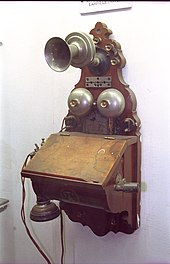
Wall phone, operator required!
See the wall phone over there? Notice, no dial. You just turned the crank to notify the operator, spoke into the horn on the top and listened by the horn on the side. Simple. When you turned the crank it would connect then disconnect the line to the operator. This line had a voltage over it, so when it connected it turned on a light at the operator's switch so she could tell who was calling. It would flash, as turning the crank connected, then disconnected the light.

Okay, it was actually a little bit more complicated than that. The operator really couldn't plug the phones lines directly into each other, there were tens of thousands of phones in Manhattan. She would actually have to make several plugs and rewire the system in real time, this was the only way they could get it to scale. A few years later there were hundreds of thousands of phones in Manhattan. Even though this is now scaling linearly with the phones it's not going to work, there aren't enough people to manually reroute the connections on every call.

Somehow, Bell needed to get rid of the operators or his business was going to fail. And again, he was a very smart man. He assigned a number to each phone. Four digits. You could have 9999 phones hooked together through a switch system. Each group of phones had three digits to identify its group. So you could have 999 groups of phones (although some of the numbers were reserved.) This means he could now support about ten million phones and every one had a unique number. Yes, the telephone number was invented. The operators got a call, you told them which number you were calling and they set the switches to route the phone call correctly. But wait, Alexander still needed all those operators! But again, Bell was a very smart man.

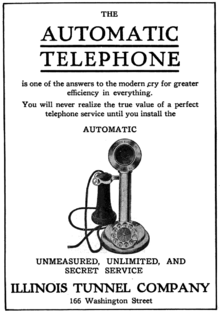
The operator flipped the switches to match the phone number you wanted to call... what if  your phone could do that all by itself? Then there would be no need for operators. That's exactly what he did. He made the phone capable of sending a signal through the wires that would flip the right switches to connect your phone up to any other of the ten million phones. How did he do that? Well if you've ever watched an old movie you see that phones used to have dials on them (that's why we call making a phone call "dialing".)  The dial was a rotary switch.

Unlike the crank the numbers on the dial told you how many times the switch would be turned on and off when you moved it all the way clockwise and let it go. Put your finger in the five hole and rotate the dial clockwise to the stop and let it go. It would connect and disconnect five times as the dial returned to its original position. So it would flash the light at the operator's switch five times. Who cares? Nobody! But....

Alexander was a very smart man.

Instead of using that signal to flash the light five times he made that signal turn another rotary switch five places. That switch now connected your phone to the fifth wire connected to that switch. Then the next number you dialed would change the next switch! And so on and so forth. If you wanted to talk to a phone in your local group,  you only needed to dial four numbers. And voila, you start ringing the phone at the other end. Now if you wanted to talk to another group of phones you could continue dialing the next three numbers and three more wires would switch and connect and all of a sudden you're talking to another phone in another group, automatically, no need for operators, you only need big buildings with big physical switches in them.

This system has been expanded to nine numbers in the US. We add the area code to the groups of switches and now you can hook up ten billion phones. Another consequence of this system is that you didn't have to use the rotary dial to dial the number, you could just press the switch that connected you with the system the right number of times to dial the number you wanted. 0 was the hardest number to dial as it was really ten connect-disconnect cycles. And you had to do it within about a second or the switch at the other end ignored you. But it was possible. It was a quirk of the system and you could hack it to dial any number you wanted.

A quick digression. How do you call a phone in another country? Well you just add a country number onto the phone number. That's why the country number for the United States is "1". We invented the phone system so we got to set up the naming. We're number one!

What a great design! But there's still some problems in the system. These switches are big. Typically they are thirty or fourty feet tall so they need a lot of building space. When you see the phone company building without any windows, that used to be just a big shell around a bunch of switches. If the phone system actually grew to ten billion phones that'd take a billion switches. There weren't enough buildings to hold all those switches and all that wire. But...

Alexander was a very smart man.

But... by now, it's the late 1950s and Alexsander is dead, so he can't fix the system. But he's invented the largest research laboratory in the world and he's got a lot of smart people working on this problem. What do they do? Did they invent the iPhone? Nope. If they had we would have gotten a picture of a rotary dial instead of the push buttons. And it would be going dit-dit-dit-dit... not beep, boop, bop. Instead they invented the "Touch-Tone" system. Instead of letting the voltage - ground - voltage move the switch, they now had a little electronic circuit that listened on the phone line for the Touch-Tone sounds. When it heard the sound for a "1" the electronic circuit turned the switch and connected up the first wire. Then when you pressed the next number and it did the same thing again. They originally used this system to connect up the groups of phones with each other. They thought they were being very clever as the signals are in the audible range and thus can be transmitted over any of the phone lines already in existence. No need for new wires anywhere! But...

They started using these tones on pay phones - the system in the switch could hear the tones that the quarter set off when you shoved it into the phone's pay slot. But it's just a tone in the audible range. So you don't need to put a quarter in the phone, you can just replay the sounds the quarter triggered when you shoved it into the pay phone slot. So with a little tone generator you could get free phone calls. Even better, they had special tones (that they published!) that would let you dial long distance phone numbers and pay for them. No need for collect calls with the tone generator (the "blue box") you could call anywhere for free.

Another quick digression. We're all the way up to the 1970s now and bright electronic students (even those in high school, like the esteemed Steve Wozniak) could figure out how to build these tone generators. One of the tones was actually able to be generated by the plastic whistle that was a prize from a box of Cap'n Crunch cereal, hence the nickname of John Draper (an early phone phreaker.)  You could sell these blue boxes, which cost a few dollars to make, for a hundred dollars because people could use it to steal long distance phone calls from the phone company. Stealing is a harsh term. It's not like the phone system noticed that one person made a free phone call and it would break the system! It wasn't even a real annoyance. The phone company didn't care. And some blue box builders made enough money to buy parts to build a personal computer. One hack finances another.

At this point Cap'n Crunch is actually working at Apple. He's building a blue box that can be controlled by an Apple computer. But the corporate side of the Wozniak/Jobs dynamic duo gets wind of it (the corporate one wasn't Woz, if you didn't know) and shuts it down. You can't have everyone who buys an Apple computer making free calls! What would this world come to? So Steve fires Draper, even though that's why he hired him in the first place. A real dick move. And not the only one the Dick, er Steve ever made, but that's for another blog post...

Back to our story about the iPhone's crappy 'dialer' interface. Again, it's not a dial, it's actually a Touch-Tone interface with simulated push buttons like the modern phones. By the 1980's the phone company figured out that putting their signalling in the audio band is a bad idea so they invented the Signaling System Seven.  ("SS7" for short. I was never sure what the other six generations of signalling were, we've only described four in this article. I doubt there were seven. There were probably way more.) So at this point in time the globally open in-band signalling system no longer works. You can't get free long distance calls by blowing a Cap'n Crunch whistle into a phone anymore. But you can still talk to the local switch using the Touch-Tones. Beep-boop-bop. All the new phones do it.

So what happens when they invent the cell phone? They don't use the Touch-Tones at all to dial, but you can do all kinds of neat things with Touch-Tones. "Press 1 for a representative." The cell phone produces a Touch-Tone signal that you can hear, then sends an electronic signal across the radio waves to the switch on the other side which recreates the actual Touch-Tone signal so the representative on the other side can ignore you for minutes at a time. The Touch-Tone signal itself is never sent over the phone lines on your end, but we still hear it. We're mimicking the original system that no longer exists! Mimesis. That's why you're iPhone still does it. Beep-boop-bop. We've been trained to expect the tones, so they gives us the tones.

When will we ever get rid of this anachronism? Who knows? With this new system there's no need for Touch-Tones, but we still have them. Maybe after the original designers die off, we'll forget to put them in the next version of the iPhone.... so it won't beep-boop- bop in your ear when you press the buttons. The new Media doesn't need the old messages.

Thanks for reading.
  -DrMike.


Quick aside. When I turn the page on an electronic book it pretends to simulate the turning of the page of a real book in three dimensions. Talk about your anachronistic medium is not the message but copying what went before is, that's the ultimate baloney interface hack.

Oh, what a tangled web we weave,
When first we practise to deceive!


Thursday, December 26, 2019

Ten Grand Technical Challenges of the 21st century: 1. Settle Space, Mars, moon, asteroids, the solar system.


Settle Space, Mars, moon, asteroids, the solar system.


The first of the Ten Grand Technical Challenges of the 21st century


TIme for some more blogging. One blog post on each of the TEN GRAND CHALLENGES of the 21st
century. The things that make us proud to be a part of the human race. The things that we should be
doing regardless of what else is true, the things that make life have meaning.


Humanity will infect the galaxy; we already are.

Humanity has a chance to make a real mark on the universe. If you look at what we've been throwing
out into space for the last 50 years, it's obvious we have some innate need to expand into new
environments. People have been in space almost continuously since 1971 (that'd be ~50 years) and I
detailed the history of the technology in this post [1] about how technology changes things.


We keep throwing robots out there as fast and as far as we can. They aren't yet killer robots (we keep
those closer to home so far [2]) but they are certainly robots. Eventually we'll be sending out ones that
can reproduce. If we will, so would the aliens. It doesn't take too long before these robots infect the
galaxy. But mostly what they do is just watch. We've been transmitting TV signals for decades, but that
means we've only announced ourselves to 100 cubic light years whereas the volume of the galaxy is
100x10^15 cubic light years. How much of the resources of a galactic civilization would be able to
focus on earth? Not very much. The correct comparison is if one atom in your body all of a sudden
started sending out electrical signals, would you notice? I wouldn't.


But, don't worry, the aliens and their killer robots will notice us sometime. I think they have already
noticed us. It's hard to miss all the hydrogen bombs we've set off since 1950. But still, even if they did
notice, it will take a long long time for them to get here. If I could only live that long [3] it would be
amazing! The only counter theory is that the robots that are watching us would now be growing aliens
from the DNA equivalent they use and operate independently. If the speed of light is really the limit on
transmitting information, living organisms as large as the galaxy are going to be very slowly acting.
For a signal to propagate to half of the galaxy takes 50,000 years. Since our recorded history is less
than 5,000 years we have no practical experience of what a society like this would be. But enough of
the wishful thinking. What are we going to do before the killer robots get here?


What's the most efficient way for Humans to infect the Galaxy?


Assuming we want to settle the galaxy most efficiently (at the least cost per year) and cost is
measured in time. Time is money, but money and time is what people's lives are made up of. People's
lives compared to the time scale of a galactic society is about 1000 to 1. Seems like they would barely
notice each other. So for now, we will ignore any effects that the alien killer robots would have
(although in my opinion, the alien killer robots are already here.) [5]


We want to put our robots and our people throughout the galaxy. Given the vast distances between
habitable areas they are going to evolve independently of each other. So we need to learn how to
guide their evolution in the right directions.


Bottom line: humans are going to infect the universe, whether you like it or not. So what is the most
efficient way to do this ? I' m a big fan of going everywhere as fast as possible. So, I'm a big fan of the
space station. We need to keep one manned forever. After the space station (which is the most
expensive structure ever built) which has been in orbit for almost 50 years, we need a base on
another planet or moon. Where should it be?


Humanity should settle on the moon first, then Mars.


In my estimation we definitely need to go to Mars. But, on our way their we need to practice putting up
a colony, and the easiest place to do that is on the moon. It's nearby, easy to deliver food and shelter
to, easy to rescue, cheaper and faster to get to than Mars. It will give us the experience we need to
learn how to inhabit other worlds. It's definitely going to be cheaper than going all the way to Mars.
Except, water is harder to come by on the moon. We'll want to be at the south pole where some water
has been found in crater shadows. We can learn how to make rocket fuel from the existing landscape,
which is critical to making a Mars colony work. If it takes us awhile to make this happen, it won't
matter on the moon as we can go fly rocket fuel to the moon, whereas getting it to Mars is extremely
expensive.


So settling on the moon has huge advantages in cost and in nearness (time to get there) over Mars. It
gives us the chance to learn how to settle humans on the first body outside of the earth and helps us
get to Mars with more confidence. We should do both, but we can start going to the moon right now.
We don't have to build a new rocket, we can use the one's we have. This is a huge advantage. We've
already settled space (the international space station) and now we need to settle moon and learn how
to settle Mars and the asteroids, of course.


What's next? The stars. [7]


"A potentially habitable, Earth-sized planet orbiting the Sun’s closest stellar neighbour—Proxima
Centauri, a mere 1.3 parsecs, or 4.22 light years, away."


Wholly cow! This planet is actually close enough for us to reach with next generation technology. And
some billionaire is helping to finance it: Starshot [8] and a list of the technology they need to develop:
mostly lightweight chip packaging (they're essentially sending a cell phone into space) and some
software and materials work on the lightsail and the laser to control the actual sailing. They've already
produced a system design of how to get to Alpha Centauri, published in the British Journal of
Interplanetary Society. [9]

On the current schedule they plan to send signals back from the Star in 2060.


Then there’s the next question: How do we actually get people onto these planets? Intergenerational
space ships? Baby farms? Teleportation? All the current ideas sound ridiculous. But just wait, it's only
a matter of time and another blog post.


Thanks for reading.
 - Dr. Mike


=======================================================


[0] We price commodities in terms of saved time. Price information the same way. This will
revolutionize economics. A way to fairly trade between realms. Realms can publish 'magic' or
technology (steps to produce something) and that something can allow a conscious entity to perform
a particular skill. A skill allows the user to cast a 'spell', a set of defined steps (algorithm) to produce a
given output. So time to output. What are examples of outputs? AIs. Cars. Rockets. Planes.
Spaceships. Energy. Nuclear power. Would we trade the hydrogen bomb around? If you don't know
how to do that, I don't see how you'd be able to listen to the galactic internet. Another blog post is due
on how you make it profitable to run an intergalactic internet? And what would you use that network
for, given the 'power' of the network is limited by the huge latencies in the galaxy: 50,000 years or
1.7x10^12 seconds. 1700 trillion seconds.


The power of a network that covers the galaxy is an interesting thing to investigate. The power of a
network is defined as the amount of information it can hold at one time. The throughput is how much
comes in or out of this repository of information, the power is how much is stored in the network, by
stored we mean information that is in transit, that is information that has been sent but not yet
received. Assuming a data rate as high as we can conceive, given physics and science. What are the
limiting factors? There are some distortions in time and phase and frequency that limit the data rates
you can transmit per hertz. And there's the fundamental limit that Claude Shannon determined. [6]


The power of a galactic network: xxx THz?


 These systems of flow are the subject of queueing theory [12] for which we define x as the average
time a customer spends in service and t as the average time between customer arrivals. Often we use
the following rate notation for these quantities: x = 1/µ (where µ is the service rate) and t = 1/λ (where
λ is the arrival rate). Further we combine these two quantities and define ρ = x/t = λ/µ as the system
efficiency (also referred to as the utilization factor); in
general, stable systems require ρ < 1.


Now this paper does not directly attack latency but ... it says: footnote 9: We do not explicitly address
latency due to speed of light, but assume such latency is included in the service time.


For a galactic civilization that latency, that service time, is 50,00 years or 170x10^15 seconds. So
µ=1/170x10^15=6x10^-12.
The arrival rate is zero right now. How much money should we invest in trying to pick up this signal?
You should be able to figure this out. The human race spends a lot of effort watching the skies. A lot.
I wonder if it's built into the genes?


How many offers per second can we expect? We can estimate this assuming trading information. Bits
produce an average saving in time of a procedure of x% per period. Or efficiency service time
increase of x% per period. It takes xxx bits to do this. We receive them at a rate of multiple Tb/s per
channel and there are one Trillion channels (every star in the galaxy.) And a technology requires
about a TB of information. That's enough to build a human being (take my word for it. Includes DNA
and experiences.)


So it's like one per second per terabit channel. Thousands? How do you trade this information? It's
rated in savings percentage per unit time. On the receiving side you have to multiply the proposed
solution by the percentage of it that is applicable to the existing situation, which will be less than 100
percent. There's always some friction in remote transactions. This is all formalized, in a paper by Paul
Krugman: "The theory of Interstellar Trade." [10]


[1] image timeline of space stations orbiting the earth
[2] radar controlled machine gun, drone
[3] what's the best estimate of the time until the aliens show up? I think we date it from the first
hydrogen bomb: 1950 according to the man who could predict something from nothing [4] there's a
95% chance of an extinction event occurring between 800 and 8 million years from now.
[5] Killer Alien Robots are already here. And you thought battlestar galactica was scary, wait until you
read the underlying books about the Berserkers by Robert Silverberg.
[6] Shannon's law is most similar to the uncertainty principle in quantum mechanics. It's hard to claim
that they aren't fundamentally related. They actually may be directly related... in that the uncertainty
principle sets the accuracy of measuring two variables simultaneously. Shannon's law sets the
amount of power required to transmit information reliably. To transmit information reliably you have
measure bits of signals accurately, this defines how much power you need to differentiate two
different signals. The detection is typically gaussianly distributed which requires the sources to be
separated by more than half their width to be able to be differentiated. This is the same requirement
made by quantum mechanics. This is the minimum noise that you will see in any system. This
quantum noise is unavoidable in the real world. It can't be edited out or corrected without sacrificing
latency. You can devise a code to run over a channel that will guarantee the data will be delivered
correctly but adds latency. According to Shannon's law the additional latency for additional accuracy
is exponential over polynomial? [XXX???} this needs filled out. Is it linear? What is the best you can
do?


[10] Economic Inquiry doi:10.1111/j.1465-7295.2009.00225.x
(ISSN 0095-2583) Online Early publication March 7, 2010
Vol. 48, No. 4, October 2010, 1119–1123 © 2010 Western Economic Association International


A Version of the “Wheat Field with Cypresses” by Vincent Van Gogh

In late 1889, Vincent van Gogh committed himself to an insane asylum , still commercially unrecognized o ne year from his death, and pain...